🃏 20 parts labelled
👆 click any marker
🔍 one real card, fully explained
20Labelled parts
11Energy types
12Rarity marks
1999–2026Eras covered
Step 1 · Pick a part

Click any numbered marker on the card. The matching explanation lights up in the list.

Step 2 · Read it

Each entry says what the symbol means in the game, and what it shows on this exact card.

Step 3 · Go deeper

Rarity marks, energy types, and older card layouts have their own sections further down the page.

The interactive card

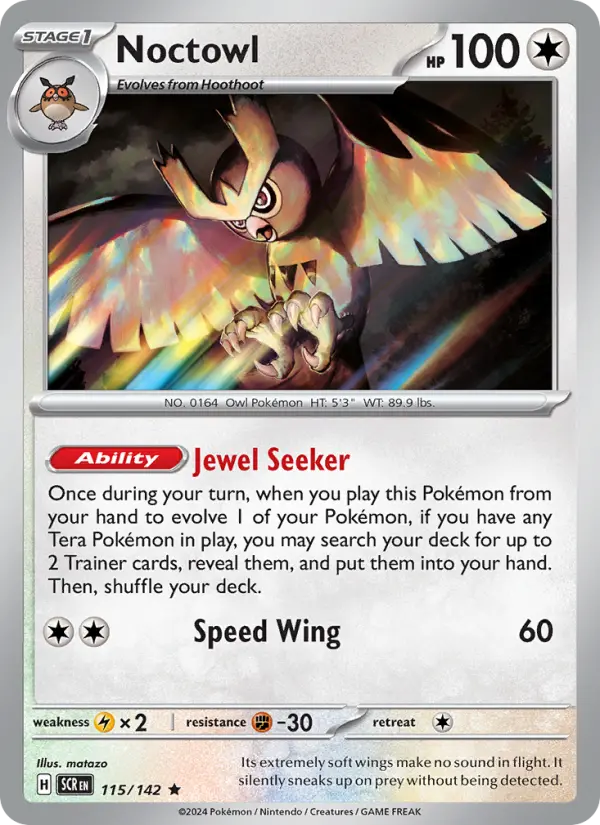
Noctowl · Stellar Crown 115/142 · released 2024

Noctowl card 115/142 from Stellar Crown with 20 numbered markers over its parts

Tap or click a numbered marker to jump to its explanation.
Tap a number in the list to light the part up on the card.

1

Stage badge

Shows how far the Pokémon is evolved: Basic, Stage 1, or Stage 2. Basic Pokémon can be played straight from your hand. A Stage 1 or Stage 2 card must be played on top of the previous stage.

On this card: Stage 1. Noctowl is played on top of Hoothoot.

2

Card name

The name of the Pokémon this card represents. A deck may contain up to four cards with the same name. Basic Energy cards are exempt from that rule.

On this card: Noctowl.

3

HP

Hit Points. The total damage the Pokémon can take before it is Knocked Out.

On this card: 100 HP.

4

Type symbol

The Pokémon’s type in the TCG type chart. Types interact with Weakness, Resistance, and many card effects. All eleven types are listed in the energy types section.

On this card: Colorless, shown as a white star.

5

Evolves from

The evolution reminder. The small picture and text name the Pokémon this card evolves from. You can only play this card onto that Pokémon while it is in play, and not on either Pokémon’s first turn in play.

On this card: Evolves from Hoothoot.

6

Illustration

The card art. Special versions of a card, such as full arts and illustration rares, change the artwork and frame but keep the same gameplay text.

On this card: Noctowl in flight, painted by matazo.

7

Species data bar

Pokédex data: the National Pokédex number, species category, height, and weight. It has no effect on gameplay.

On this card: No. 0164, the Owl Pokémon, 5'3" and 89.9 lbs.

8

Ability

An effect that is not an attack, marked with the red Ability label. Abilities cost no Energy to use. Each one states when it works.

On this card: Jewel Seeker. When you play Noctowl to evolve one of your Pokémon while you have a Tera Pokémon in play, you may search your deck for up to two Trainer cards.

9

Attack cost

The Energy that must be attached to this Pokémon before it can use the attack. Each symbol is one Energy of that type. Colorless symbols accept Energy of any type.

On this card: Speed Wing costs two Energy of any type.

10

Attack name and damage

The attack’s name and the damage it deals to the opponent’s Active Pokémon. Attacks with extra effects print rules text below the name. Many Pokémon have two attacks stacked in this area.

On this card: Speed Wing, 60 damage, no extra effect.

11

Weakness

Attacks from Pokémon of this type deal extra damage. On modern cards Weakness doubles the damage.

On this card: Lightning ×2. A 60-damage Lightning attack hits Noctowl for 120.

12

Resistance

The opposite of Weakness. Attacks from Pokémon of this type deal less damage, minus 30 on modern cards. Many Pokémon have no Resistance at all.

On this card: Fighting −30.

13

Retreat cost

The number of Energy you must discard from this Pokémon to retreat it to the Bench. Some Pokémon have no symbols here and retreat for free.

On this card: One Energy of any type.

14

Illustrator credit

The artist who drew the card. Every Pokémon card credits its illustrator here. Bill’s Archive keeps a full artist database.

On this card: Illus. matazo.

15

Regulation mark

A letter that controls which cards are legal in the Standard tournament format. Roughly once a year the oldest legal letter rotates out. Marks first appeared on English cards in the Sword & Shield era in 2020.

On this card: Regulation mark H.

16

Set code

The expansion the card belongs to. English cards from the Scarlet & Violet era onwards print a set code here instead of the older pictorial set symbol. The small EN marks the print language. Older symbols are charted on the set symbols page.

On this card: SCR, which is Stellar Crown.

17

Card number

The card’s number within its set. Cards numbered higher than the printed set size are the set’s secret rares.

On this card: 115 of 142.

18

Rarity symbol

The small mark after the card number. A circle is Common, a diamond is Uncommon, a star is Rare. Modern special cards add further star tiers, and the star’s colour sets the tier. All twelve marks are listed in the rarity section.

On this card: A black star. This Noctowl is a standard Rare.

19

Flavour text

A short Pokédex-style entry. It has no gameplay effect. Pokémon ex and other special cards drop it to make room for their rules boxes.

On this card: A note about Noctowl’s silent flight.

20

Copyright line

The legal line naming the Pokémon rights holders: Nintendo, Creatures, and GAME FREAK, plus the year of the print run.

On this card: ©2024.

Rarity symbols

Scarlet & Violet era onwards · star colour sets the tier

Common

A black circle. The bulk of every set.

Uncommon

A black diamond. Harder pulls than Commons.

Rare

A black star. Modern Rares are all holographic; vintage holos use this same star.

★★

Double Rare

Two black stars. Standard Pokémon ex cards.

Illustration Rare

One gold star. Full-art regular Pokémon with a glossy sheen, numbered past the set size.

★★

Ultra Rare

Two silver stars. Full Art Pokémon ex and Trainer cards.

★★

Special Illustration Rare

Two gold stars. Premium alternate artwork, the top modern chase tier.

Mega Attack Rare

One pink and one green star. Mega Pokémon ex, introduced in Ascended Heroes (2025).

★★★

Hyper Rare

Three gold stars. Gold-etched cards.

Futuristic Rare

No star. An opalescent colour-shift finish marks it. Debuts in 30th Celebration (September 2026).

ACE SPEC

A pink star. Trainer and Energy cards limited to one ACE SPEC per deck.

Promonot set-numbered

A black star with the word PROMO. Numbered to a promo series instead of a set.

Star colour sets the tier. Two black stars mark a Double Rare; two gold stars mark a Special Illustration Rare. Check the colour, not just the count.

Before Scarlet & Violet every premium tier shared the single black star. Holo Rares, V and VMAX, Full Arts, Alternate Arts, Rainbow Rares, and gold Secret Rares were told apart by the card style, not the symbol. Secret rares are numbered past the set size in every era.

Shiny Pokémon subsets and other special products add their own variants. The full era-by-era history is in the rarities guide.

Energy types

The eleven TCG types and the video-game types they cover

Grass

Grass and most Bug Pokémon.

Fire

Fire Pokémon.

Water

Water and most Ice Pokémon.

Lightning

Electric Pokémon.

Psychic

Psychic, Ghost, and Fairy Pokémon.

Fighting

Fighting, Rock, and most Ground Pokémon.

Darkness

Dark Pokémon.

Metal

Steel Pokémon.

Dragon

Dragon Pokémon. No basic Dragon Energy exists, so Dragon attacks cost other Energy types.

Colorless

Normal and most Flying Pokémon. Colorless costs accept any Energy.

Fairyretired

Used from the XY era until 2020. Fairy Pokémon are now printed as Psychic.

How older cards differ

Reading cards from earlier eras

Set symbol, not set code

Cards printed before Scarlet & Violet carry a small pictorial set symbol instead of a code. Match it on the set symbols chart to identify the set.

No regulation mark

Regulation marks began in the Sword & Shield era in 2020, starting with the letter D. Anything without a mark is long out of the Standard format.

Powers before Abilities

Vintage cards say Pokémon Power. The EX era split these into Poké-Power and Poké-Body. Ability has been the term since 2011.

Different Weakness maths

Weakness and Resistance values changed over time. Some eras printed +10, +20 or +30 Weakness and −20 Resistance instead of the modern ×2 and −30.

1st Edition stamps

Early sets from 1999 to 2003 had limited first print runs marked with a 1st Edition stamp beside the artwork. These usually sell for more than unlimited copies.

Trainer and Energy cards

They share the same bottom fine print: set code, number, rarity, and regulation mark. Instead of HP and attacks they carry rules text.

About the example card. Noctowl 115/142 is from Stellar Crown, released in 2024. Its layout matches every standard Pokémon card in the Scarlet & Violet era.

Card image and design are © The Pokémon Company, shown here for identification and education.

Related tools: set symbol chart · card artist database · TCG release calendar.