The Ultimate Guide to Poncho Pikachu Cards & Boxes
Everything on the Poncho Pikachu promo series in one place: the complete list of every card, what came inside each Special Box, and why these Japan-only Pokémon Center cards command thousands of dollars — from the Mega Tokyo grand opening in 2014 to the Team Rainbow Rocket campaign of 2018.
What Are Poncho Pikachu Promos?
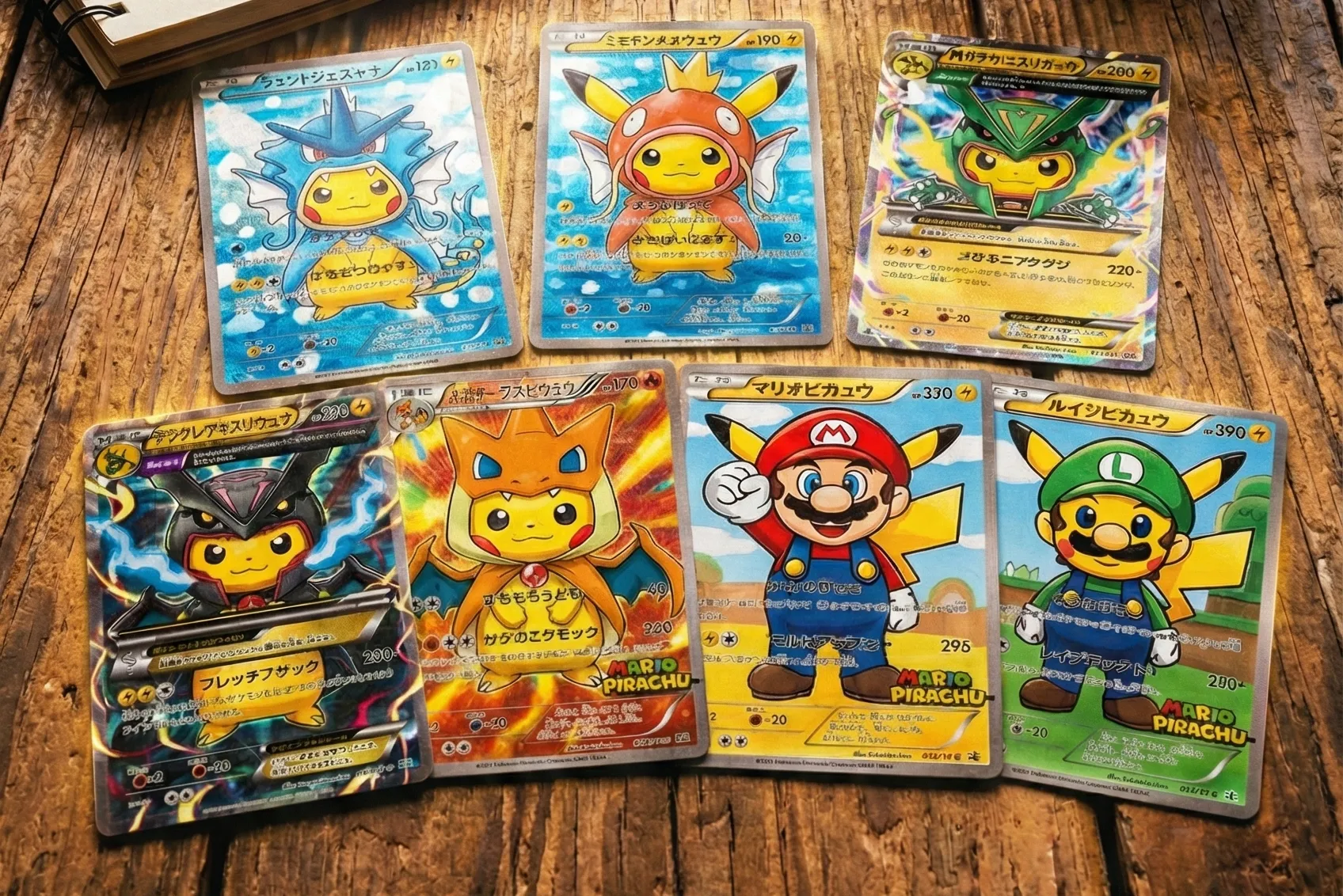
Poncho Pikachu cards — known in Japanese as Poncho o Kita Pikachu (“Poncho-wearing Pikachu”) — are a series of exclusive Japanese Pokémon Center promotional cards released between 2014 and 2018. Each card depicts Pikachu wearing a poncho styled after another popular Pokémon, from Mega Charizard X and Y to Rayquaza, Alolan Vulpix, and Magikarp. They were handed out at store openings, awarded at competitive events, or sealed inside collectible Poncho Pikachu Special Boxes. Crucially, they were never released in English — which is a large part of why they’re so sought-after today.
There’s a version of events where the Poncho Pikachu series never becomes a big deal. A few store-opening promos, some cute Kouki Saitou artwork, and a handful of hard-core Japanese collectors keeping them in binders. That’s not what happened.
Instead, the Poncho o Kita Pikachu (“Poncho-wearing Pikachu”) series became the gold standard for Pokémon promotional cards. PSA 10 copies of the Mega Charizard X variant have sold for over $16,000 at peak (2023–2024), though these cards are highly volatile and illiquid compared to established benchmarks like Base Set Charizard. The Shiny Rayquaza card nearly quintupled in value between 2022 and 2024. And a single event-exclusive holo — 204/XY-P — distributed only at Pokémon Center Mega Campaign events, remains one of the most elusive cards in the series despite a print run likely in the low tens of thousands.
This is the full story of how it happened.
The Poncho Pikachu cards were never released in English. Every copy in Western hands came via proxy services or third-party Japanese sellers — a limitation that, ironically, is one of the biggest reasons they’re so valuable today.
Origins: The “Mega Evolution” of Retail Space
The series begins with a store move. In late 2014, The Pokémon Company announced it was relocating the Tokyo flagship Pokémon Center from Hamamatsu-chō — where it had sat since 2007 — to the Sunshine City complex in Ikebukuro. The new store would be branded Pokémon Center Mega Tokyo, timed deliberately to match the “Mega Evolution” theme running through the X and Y games.
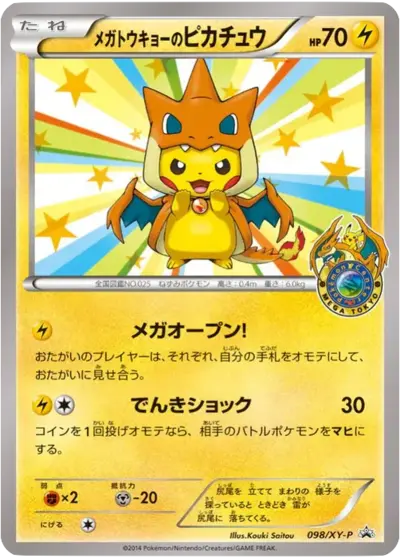
The original Hamamatsu-chō store had used Piplup as its secondary mascot. Mega Tokyo adopted Pikachu and Mega Charizard Y. And to mark the occasion — opening day was December 12, 2014 — the first Poncho Pikachu card was born: a non-holo promo (098/XY-P) given to every customer who made a purchase at the new location, available through January 16, 2015.
The Scarcity That Started Everything
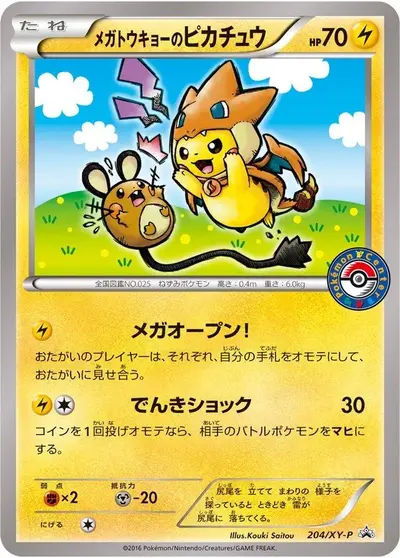
The opening card (098/XY-P) established the template, but it was the second release that set the series’ value ceiling. Card 204/XY-P shared the Mega Charizard Y poncho design but featured a different scene — Pikachu startling a Dedenne — and was distributed at “Mega Battle” events held across Pokémon Centers in Japan during the winter 2015–2016 campaign, a full year after the store opening. The interactive event format, combined with a narrow distribution window, kept high-grade survivors scarce. The PSA population for this card sits above 1,400 (as of early 2024), suggesting a total print run in the low tens of thousands — rare, but not in the same bracket as true “Trophy” cards like the No. 1 Trainer. PSA 10 examples have sold for upwards of $5,500.
| Card | Design | Released | Method | Notes |
|---|---|---|---|---|
| 098/XY-P | Mega Tokyo’s Pikachu | Dec 2014 | Purchase bonus, Mega Tokyo only | Non-holo; first release |
| 204/XY-P | Mega Tokyo’s Pikachu | Jan 2016 | Mega Campaign event participation | Holo; PSA population 1,400+ (early 2024) |
The “Pretend” Series and Regional Identity
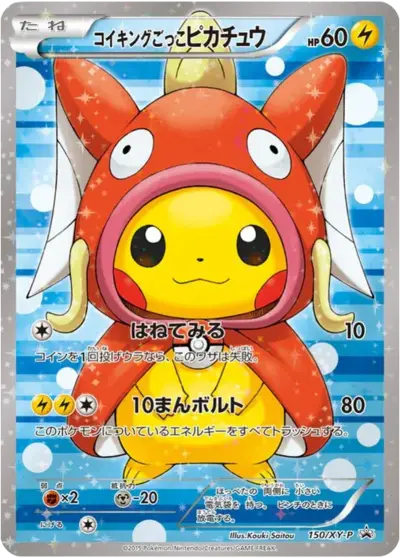
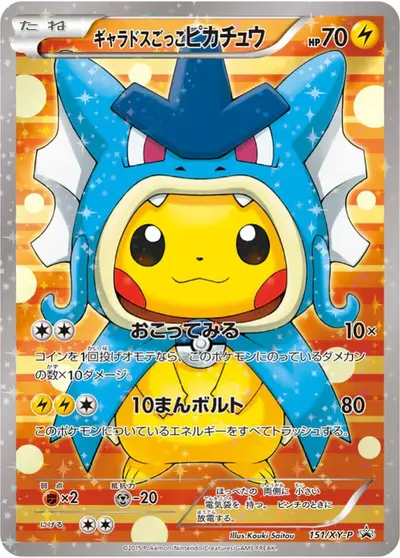
As the concept matured, the Pokémon Company began using it to anchor new store openings to their local environments. In June 2015, the Pokémon Center Hiroshima opened — and chose Magikarp and a Shiny (Red) Gyarados as its mascots, a deliberate nod to the city’s famous Hiroshima Toyo Carp baseball team and the local symbolism of the climbing carp.
This produced two new cards: 150/XY-P (Pretend Magikarp Pikachu) and 151/XY-P (Pretend Gyarados Pikachu), both included in the Hiroshima Special Box alongside five Bandit Ring booster packs. These were the first Poncho cards to use Full Art formatting — a decision that became the template for all subsequent high-end releases. The shift in language from “Poncho-wearing” to “Pretend” (Gokko) was subtle but telling: the emphasis was shifting from costume to character.
The Hiroshima cards also established the Special Box as the primary vehicle for high-value Poncho distributions. Unlike the Tokyo promos, which were loose cards handed across a till, these arrived sealed in a product — which means sealed boxes command a significant additional premium today.
The Peak: 2016 Special Boxes
By 2016, the series had the full attention of the Japanese collector community. The Pokémon Company responded by commissioning veteran illustrator Kouki Saitou for a sustained run of high-detail artworks, each capturing both Pikachu’s personality and the Mega Evolved Pokémon it was impersonating.
The Charizard Duo
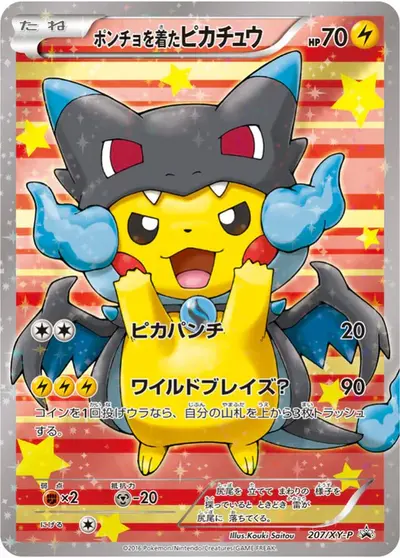
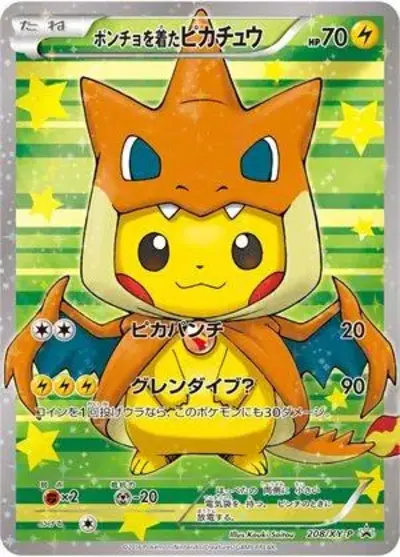
On January 1, 2016 — a deliberate New Year’s Day release — two separate Special Boxes dropped simultaneously. One for Mega Charizard X, one for Mega Charizard Y. Cards 207/XY-P and 208/XY-P respectively. These are widely considered the artistic and economic peak of the entire run.
The X variant (207/XY-P) leans into the aggressive, blue-flame energy of that form — a combat-ready Pikachu bracing for battle. The Y variant (208/XY-P) captures something more regal, befitting a Pokémon built around Special Attack and aerial dominance. PSA 10 copies of 207/XY-P have sold for over $16,000, making it the blue-chip standard by which every other Poncho card is measured.
The Skytree Town Rayquaza Release
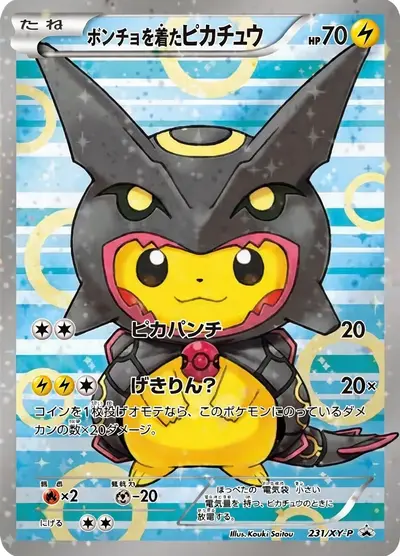
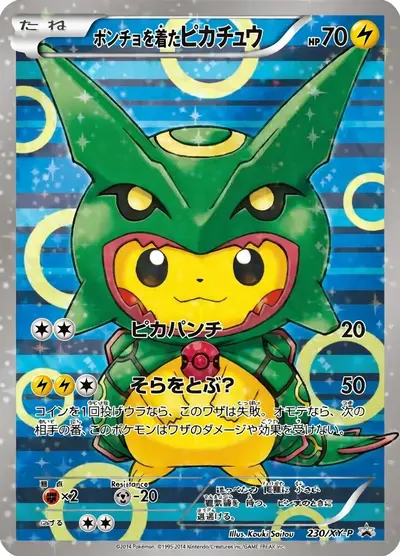
In July 2016, the opening of Pokémon Center Skytree Town — located at the base of the Tokyo Skytree tower — made the mascot choice obvious: Rayquaza, the legendary sky-dweller. The resulting Special Box contained both a standard and Shiny Rayquaza variant (230/XY-P and 231/XY-P). The Shiny version has since become a particular standout in the market, its asking price nearly quintupling between 2022 and 2024 as demand from the opening Chinese collector market drove a sustained buy-in.
The Play Point System: Competitive Rewards
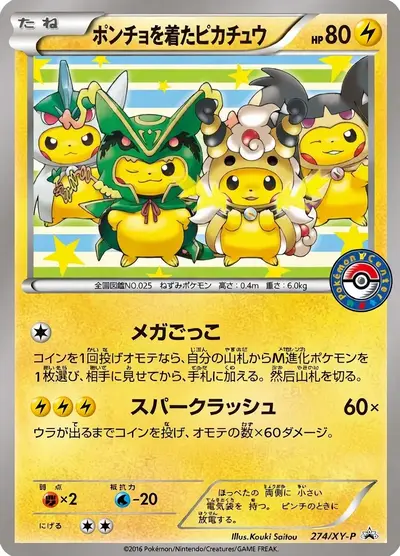
While Special Boxes catered to retail collectors, the Pokémon Company also used the series to reward competitive play. During the Pokémon Center Mega Battle events (July 23 – August 31, 2016), players earned “Play Points” by participating in sanctioned matches. Two unique non-holo Poncho cards — 274/XY-P and 275/XY-P — were available for 3 Play Points each, with a capped number of points earnable per event.
These are among the hardest Poncho cards to obtain. Card 274/XY-P features a trio of Pikachus dressed as Mega Lucario, Mega Audino, and Mega Slowbro. Card 275/XY-P mirrors this with Mega Lopunny, Mega Diancie, and Mega Gardevoir. The “multi-character” format is unique in the set, and the event-exclusive nature means the population is genuinely tiny — collectors report difficulty finding even raw copies in good condition.
The Play Point non-holos represent the most difficult-to-obtain cards in the entire XY-P run — harder even than the famous 204/XY-P, because at least that one could be obtained by attending any Pokémon Center in Japan. The Mega Battle promos required competitive commitment.
Transition to Sun & Moon: SM-P Promos
The switch from Generation VI to VII retired the Mega Evolution theme, but the Poncho concept was too commercially proven to abandon. It continued under the new SM-P promotional prefix, adapting to the Alola region’s “Regional Forms” aesthetic.
The Vulpix Fire & Ice Campaign
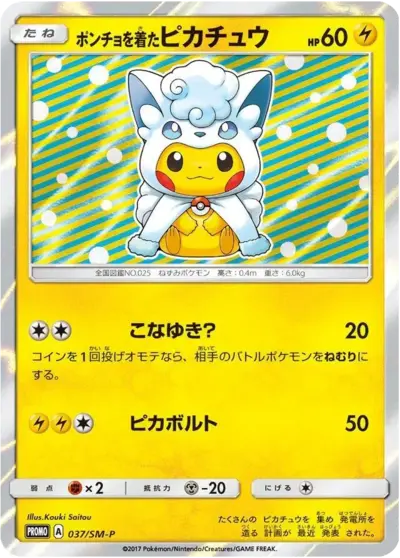
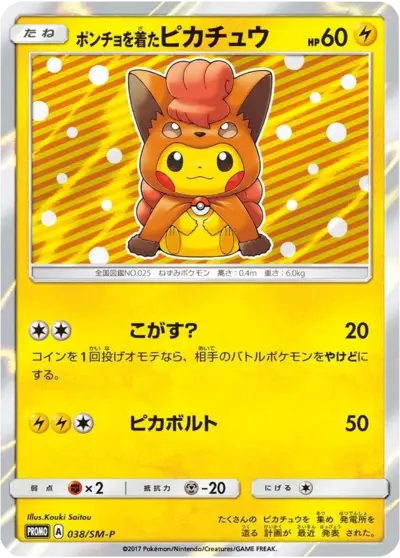
February 2017 brought the first major SM-P Poncho release: the Alolan Vulpix & Vulpix Poncho-wearing Pikachu Special Box. The product was leaner than its XY predecessors — three booster packs (two Sun & Moon, one Alolan Moonlight) instead of five — but maintained Full Art quality across both cards: 037/SM-P (Alolan Vulpix) and 038/SM-P (standard Vulpix). The Alolan version now commands around $844 ungraded, with PSA 10 copies reaching over $2,300, tracking closely with the upward trajectory established by the XY series.
Tohoku and Rowlet
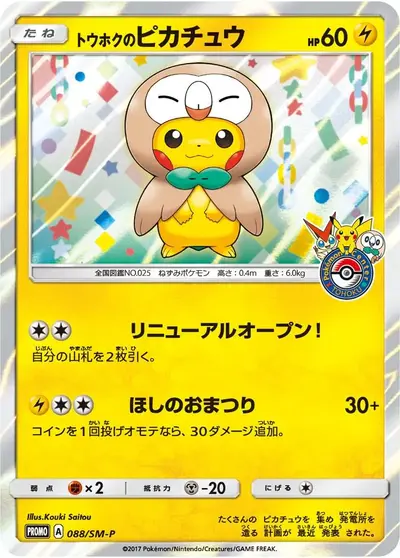
Mid-2017’s 088/SM-P — “Tohoku’s Pikachu” — released to commemorate the Tohoku store relocation and featured Pikachu in a Rowlet poncho, the first time a newly introduced starter Pokémon received the treatment. This signalled a deliberate shift away from the Mega Evolution exclusivity that had defined the XY run.
The Boss Pikachu Series
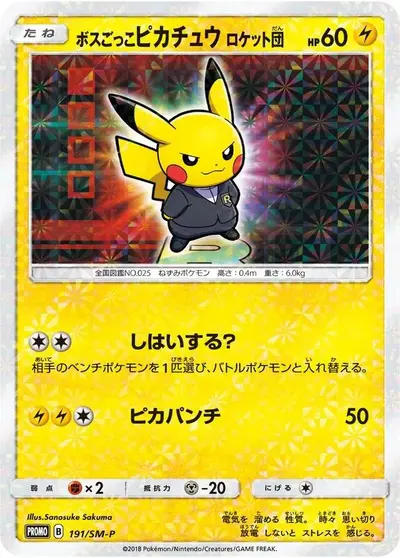
In early 2018, the series took its sharpest creative turn. To coincide with the “Team Rainbow Rocket’s Ambition” endgame content in Pokémon Ultra Sun and Ultra Moon — which united every villainous team leader from franchise history — seven “Pretend Boss Pikachu” cards were released simultaneously.
Cards 191/SM-P through 197/SM-P depicted Pikachu in tailored suits styled after Giovanni, Archie, Maxie, Cyrus, Ghetsis, Lysandre, and Guzma respectively. The artwork, handled by Sanosuke Sakuma rather than Kouki Saitou, brought a sharper, more modern sensibility: clean lines, specific villain iconography (Lysandre’s gear, Guzma’s chains), and a colour palette anchored to each team’s branding.
| Card | Boss / Team | Artist |
|---|---|---|
| 191/SM-P | Giovanni — Team Rocket | Sanosuke Sakuma |
| 192/SM-P | Archie — Team Aqua | Sanosuke Sakuma |
| 193/SM-P | Maxie — Team Magma | Sanosuke Sakuma |
| 194/SM-P | Cyrus — Team Galactic | Sanosuke Sakuma |
| 195/SM-P | Ghetsis — Team Plasma | Sanosuke Sakuma |
| 196/SM-P | Lysandre — Team Flare | Sanosuke Sakuma |
| 197/SM-P | Guzma — Team Skull | Sanosuke Sakuma |
The distribution mechanic was deliberately difficult: one random card from the pool of seven for every five booster packs purchased at a Pokémon Center, available only while stocks lasted. Completing the set of all seven required either repeated purchases, trading, or secondary market spending — and that gambling-style structure created immediate scarcity from day one.
The Wider Cosplay Family
The Poncho series wasn’t an isolated run. Its success spawned a broader “cosplay Pikachu” category of promos sharing the same DNA.
Mario & Luigi (October 2016)
A Nintendo crossover produced two Special Boxes in October 2016, each containing two Full Art and two non-holo cards of Pikachu dressed in Mario and Luigi’s iconic plumber outfits (293–296/XY-P). These followed the Poncho format so closely — same box structure, same Kouki Saitou credits — that they’re considered part of the complete collection by most serious hobbyists.
Minor Variants
Several other thematic Pikachu promos orbited the main series during the same period:
The Complete List of Poncho Pikachu Cards
Below are the eight cards that define the Poncho Pikachu series as a collector’s pursuit — from the opening promo to the villainous Team Skull / Team Rocket pivot. For every known card across both the XY-P and SM-P eras, including release dates and distribution method, see the full Poncho Pikachu card reference table at the foot of this guide.
Poncho Pikachu Special Boxes
While the earliest Poncho promos were loose cards handed across a Pokémon Center till, the most collectible releases arrived as sealed Poncho Pikachu Special Boxes. Starting with the Hiroshima box in June 2015, this became the primary vehicle for the Full Art cards — and because they shipped sealed in a product, mint examples survived in far greater numbers than the loose promos, while sealed boxes themselves now command a substantial premium.
A typical Poncho Pikachu Special Box contained:
- The Full Art Poncho Pikachu promo cards — one or two per box (for example, both the standard and Shiny Rayquaza in the Skytree Town box, or Alolan Vulpix and standard Vulpix in the 2017 box).
- Booster packs — five packs in the XY-era boxes (e.g. Bandit Ring for Hiroshima), trimmed to three packs in the leaner Sun & Moon boxes.
- Themed accessories — matching card sleeves and, in several boxes, a deck box decorated with the same poncho artwork.
The headline boxes collectors chase are the two New Year’s Day 2016 releases — the Mega Charizard X Special Box (207/XY-P) and the Mega Charizard Y Special Box (208/XY-P) — followed by the July 2016 Skytree Town Rayquaza box and the 2017 Alolan Vulpix box. A factory-sealed Mega Charizard box in good condition is one of the most desirable single items in the entire Poncho category.
Buying sealed? Verify the outer shrink and the box flap seals carefully. Because sealed Poncho Pikachu boxes carry such a large premium over their loose contents, they are a frequent target for resealing — weigh the box, check print registration on the artwork, and buy from reputable Japanese sellers or graded/sealed-authenticated listings where possible.
Why Are Poncho Pikachu Cards So Expensive?
The 2020 Pokémon card boom lifted all boats — but Poncho Pikachus rose faster and further than almost anything else. A few converging factors explain why these cards became so expensive.
Regional Exclusivity
These cards were never officially sold outside Japan. The Pokémon Company International had no equivalent retail programme in Western markets, meaning every copy that made it to Europe or North America arrived through proxy services. That artificially low supply in the West creates a “forbidden fruit” dynamic that drives prices structurally higher than the equivalent Japanese demand alone would justify.
The Chinese Market Opens
The opening of the simplified Chinese TCG market in late 2022 introduced a new wave of high-net-worth collectors who treated Japanese promos as established grails. The Charizard and Rayquaza Ponchos doubled or tripled in value within months as this new demand base bought aggressively into PSA 10 copies.
Population Rarity and the “Trophy” Effect
Because these cards were loose promos or included in boxes with minimal protection, the number of surviving Gem Mint copies is disproportionately low. A PSA 10 of 207/XY-P exists in a population of 232 registered copies. Compare that to the 20th Anniversary Festa Pikachu, which has over 1,000 PSA 10s, or the Van Gogh Pikachu with 50,000+ — and you understand the “trophy” premium.
High-net-worth collectors increasingly focus on population counts rather than raw pricing. A PSA 10 pop of 200 is viewed as a “trophy”. A pop of 50,000 is a commodity. The distinction drives a flex economy where buyers will pay 4–10x the ungraded price for a slab — and Poncho Pikachus sit firmly in trophy territory.
Poncho Pikachu FAQ
How many Poncho Pikachu cards are there?
Across the XY-P and SM-P eras there are roughly 30 Poncho and closely related Cosplay Pikachu promo cards. That total includes multi-card sets such as the seven Pretend Boss Pikachu cards (Giovanni, Archie, Maxie, Cyrus, Ghetsis, Lysandre and Guzma of Team Skull) and the four-card Mario & Luigi crossover. The complete reference table below lists every one.
What was the first Poncho Pikachu card?
The first was 098/XY-P, “Mega Tokyo’s Pikachu,” a non-holo card given to customers at the Pokémon Center Mega Tokyo grand opening on 12 December 2014.
Were Poncho Pikachu cards ever released in English?
No. Every Poncho Pikachu card was a Japan-only Pokémon Center exclusive. Copies in Western collections arrived through proxy buying services or third-party Japanese sellers, which is one of the biggest drivers of their scarcity and price outside Japan.
Which Poncho Pikachu card is the most valuable?
The Mega Charizard X card (207/XY-P) is the benchmark grail — PSA 10 copies have sold for over $16,000. The Mega Charizard Y (208/XY-P) and Shiny Rayquaza (231/XY-P) cards follow as the next most sought-after pieces.
Saitou vs. Sakuma: Two Visions of Pikachu
The artistic split between the XY-P era and the SM-P Boss series is worth examining on its own terms. Kouki Saitou handled the vast majority of the Pokémon-based ponchos, and his style is foundational to the series’ success: soft “kawaii” proportions, large expressive eyes, tactile shading that makes you want to reach through the card. The Pretend Magikarp (150/XY-P) is his signature achievement here — balancing the inherent comedy of Pokémon’s most helpless creature against Full Art execution without either element undermining the other.
Sanosuke Sakuma’s Boss series work operates on entirely different psychological levers. Sharp tailoring, character-specific accessories scaled to Pikachu’s frame, villain colour palettes — it’s designed to trigger nostalgia and “lore collector” instincts in older fans. The stylistic divergence was deliberate and effective: Saitou appealed to those who wanted something adorable and magical; Sakuma appealed to those who wanted something cool and commemorative.
Legacy and Current Standing
The Poncho Pikachu series now occupies “legacy” status in the hobby. Newer Pokémon Center promos — the Felt Hat Pikachus, the Yu Nagaba collaborations — generate significant hype but operate on fundamentally different rarity and distribution models. The Poncho cards remain the benchmark against which all store-opening promos are measured.
The limited distribution of 204/XY-P and the event-restricted Play Point non-holos ensure the set will never be easily completed by most collectors. As original holders age out of the hobby or tighten their grip, open-market supply continues to shrink while demand — particularly from Asian markets — grows. For cards with this profile, the long-term value floor tends to be resilient.
Whether you’re trying to complete the set, track down a single grail card, or simply understand why a Pikachu in a fish costume sells for thousands of dollars — the Poncho series is the most complete expression of what makes Pokémon TCG promos special: rarity, art, story, and timing all converging at once.
Complete Card Reference
All known Poncho and Cosplay Pikachu promotional cards from the XY-P and SM-P eras, listed in card number order within each series. Highlighted rows are the key collector pieces. Literal English translations of the Japanese card names.
| Card No. | Era | Release Date | Name | Release Occasion & Notes |
|---|---|---|---|---|
 025/XY-P |
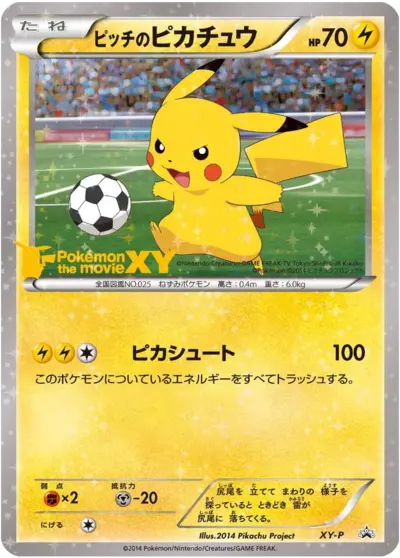
XY-P | Spring 2014 | ピッチのピカチュウ A Pitch's Pikachu A |
J-League Collaboration — 2014 FIFA World Cup. First of two cards. Pikachu in the Japan national football team kit. Low card number confirms early XY-era release. |
 026/XY-P |
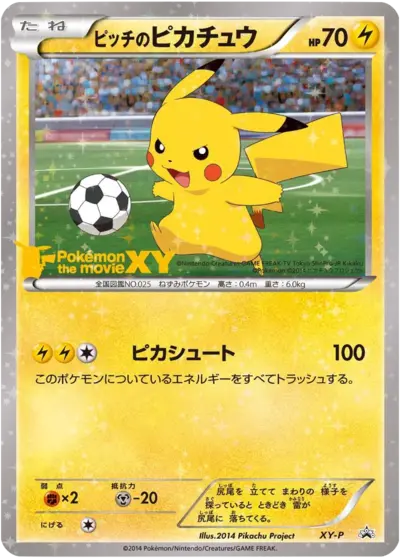
XY-P | Spring 2014 | ピッチのピカチュウ B Pitch's Pikachu B |
J-League Collaboration — 2014 FIFA World Cup. Second variant. Pikachu in the Japan national football team kit. |
 098/XY-P |
XY-P | 12 Dec 2014 | メガトウキョウのピカチュウ Mega Tokyo's Pikachu |
Store Opening — Pokémon Center Mega Tokyo. Mega Charizard Y poncho (roaring pose). Purchase bonus; available until 16 Jan 2015. Non-holo. |
150/XY-P |
XY-P | 26 Jun 2015 | コイキングのごっこをしたピカチュウ Pretend Magikarp Pikachu |
Store Opening — Pokémon Center Hiroshima. Included in Hiroshima Special Box alongside 151/XY-P. First Full Art Poncho card. Magikarp chosen as nod to Hiroshima Toyo Carp. |
151/XY-P |
XY-P | 26 Jun 2015 | シャイニーギャラドスのごっこをしたピカチュウ Pretend Gyarados Pikachu |
Store Opening — Pokémon Center Hiroshima. Included in Hiroshima Special Box alongside 150/XY-P. Shiny (Red) Gyarados poncho. Full Art. |
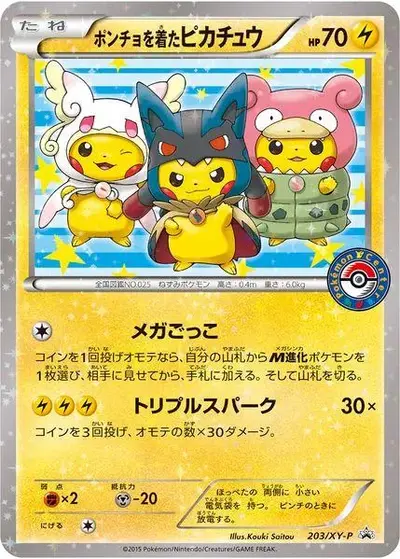 203/XY-P |
XY-P | Dec 2015 | ポンチョを着たピカチュウ Poncho-wearing Pikachu (Mega Audino) |
Mega Campaign — Purchase bonus. Features Pikachu in a Mega Audino poncho. Distinct from the group illustration on the Play Point card 274/XY-P. |
204/XY-P |
XY-P | Jan 2016 | メガトウキョウのピカチュウ (デデンネ) Mega Tokyo's Pikachu (Dedenne scene) |
Mega Battle Event — Distributed at events. Holo. Rare “Dedenne scene” variant of the Charizard Y poncho. PSA population above 1,400 as of early 2024; PSA 10 examples have sold over $5,500. |
207/XY-P |
XY-P | 1 Jan 2016 | メガリザードンX着のピカチュウ Mega Charizard X Poncho Pikachu |
Special Box — New Year’s Day release. The blue-chip grail of the series. Full Art by Kouki Saitou. PSA 10 copies have exceeded $16,000 at peak (2023–2024); highly volatile and illiquid. |
208/XY-P |
XY-P | 1 Jan 2016 | メガリザードンY着のピカチュウ Mega Charizard Y Poncho Pikachu |
Special Box — New Year’s Day release. Paired with 207/XY-P; released simultaneously. Full Art by Kouki Saitou. Regal aerial composition. |
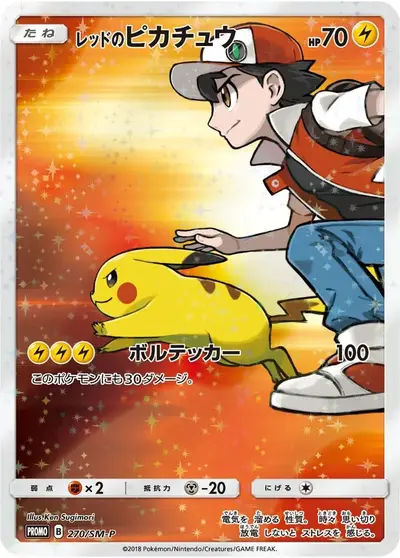 270/XY-P |
XY-P | Feb 2016 | レッドのおきにいりのピカチュウ Pikachu in Red's Outfit |
20th Anniversary Campaign. Full Art by Kouki Saitou. Not a poncho card, but same format and artist — universally collected alongside the Poncho series. Solo release; no paired card. |
230/XY-P |
XY-P | Jul 2016 | レックウザ着のピカチュウ Rayquaza Poncho Pikachu |
Store Opening — Pokémon Center Skytree Town. Included in Skytree Town Special Box alongside 231/XY-P. Rayquaza chosen to reflect the tower’s height. Full Art. |
231/XY-P |
XY-P | Jul 2016 | 色違いレックウザ着のピカチュウ Shiny Rayquaza Poncho Pikachu |
Store Opening — Pokémon Center Skytree Town. Included in Skytree Town Special Box alongside 230/XY-P. Value rose from ~$233 (2022) to over $1,175 (2024). Full Art. |
274/XY-P |
XY-P | Jul–Aug 2016 | メガバトルのピカチュウ (Group A) Mega Battle Pikachu (Group A) |
Play Point Exclusive — 3 Points required. Non-holo. Group illustration: Mega Lucario, Mega Audino, and Mega Slowbro. One of the hardest non-holos in the entire set to obtain in high grade. |
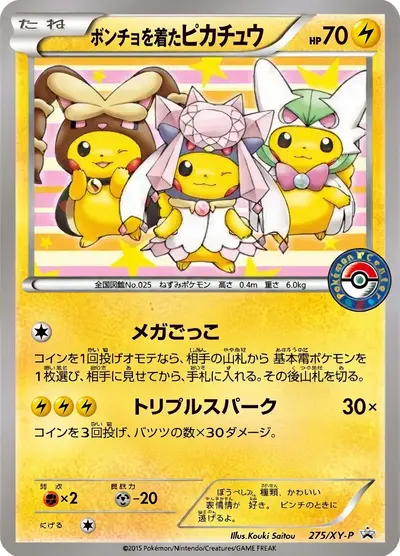 275/XY-P |
XY-P | Jul–Aug 2016 | メガバトルのピカチュウ (Group B) Mega Battle Pikachu (Group B) |
Play Point Exclusive — 3 Points required. Non-holo. Group illustration: Mega Lopunny, Mega Diancie, and Mega Gardevoir. Paired with 274/XY-P; required separate point expenditure. |
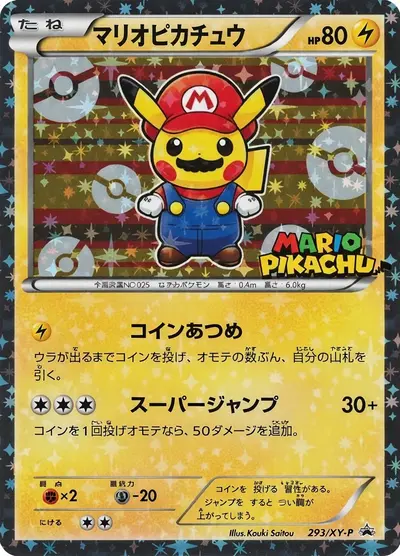 293–296/XY-P |
XY-P | Oct 2016 | マリオ / ルイージのピカチュウ Mario & Luigi Pikachu |
Nintendo Collaboration — Special Boxes. Two separate boxes (Mario and Luigi). Each box includes one Full Art (293, 295) and one non-holo (294, 296). Considered canonical Poncho-era collection pieces. |
 037/SM-P |
SM-P | Feb 2017 | アローラのロコン着のピカチュウ Alolan Vulpix Poncho Pikachu |
Special Box — Alolan Vulpix & Vulpix Box. Full Art. Capitalised on Alolan Vulpix’s debut popularity in Sun & Moon. PSA 10 copies ~$2,300+. |
 038/SM-P |
SM-P | Feb 2017 | ロコン着のピカチュウ Vulpix Poncho Pikachu |
Special Box — Alolan Vulpix & Vulpix Box. Standard Kanto Vulpix poncho. Paired with 037/SM-P. Full Art. |
 088/SM-P |
SM-P | Jun 2017 | トウホクのモクロー着のピカチュウ Tohoku's Rowlet Poncho Pikachu |
Store Relocation — Pokémon Center Tohoku. Rowlet chosen as the store’s new mascot. First Generation VII starter to receive the Poncho treatment. |
 191–197/SM-P |
SM-P | 20 Jan 2018 | ボスのマネをしたピカチュウ (7枚) Pretend Boss Pikachu (7 cards) |
Rainbow Rocket Campaign — Random distribution. One card at random per 5 booster packs purchased. Giovanni (191), Archie (192), Maxie (193), Cyrus (194), Ghetsis (195), Lysandre (196), Guzma (197). Art: Sanosuke Sakuma. |
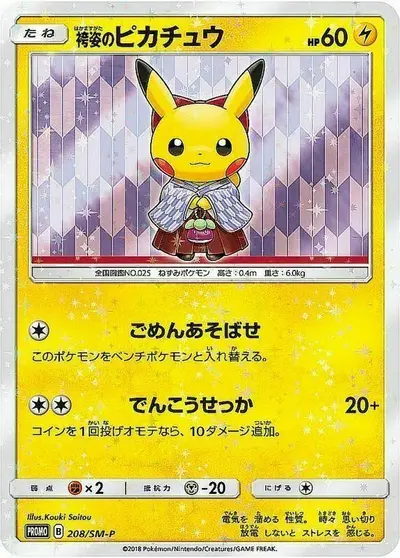 208/SM-P |
SM-P | Mar 2018 | 消防士のピカチュウ Firefighter Pikachu |
Store Opening — Pokémon Center Tokyo DX. Traditional hikeshi (Edo-period firefighter) attire. Paired with 209/SM-P. |
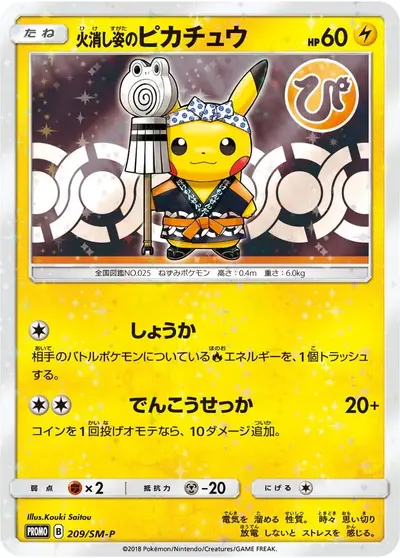 209/SM-P |
SM-P | Mar 2018 | 袴着のピカチュウ Hakama Pikachu |
Store Opening — Pokémon Center Tokyo DX. Traditional hakama formal wear. Paired with 208/SM-P. |
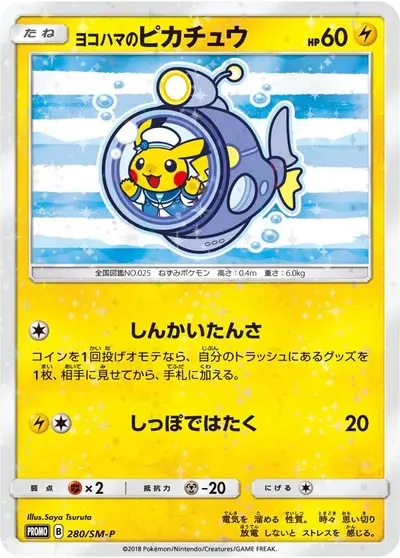 280–283/SM-P |
SM-P | Nov 2018 | ヨコハマのピカチュウ (4枚) Yokohama's Pikachu (4 cards) |
Store Opening — Pokémon Center Yokohama. Four-card set featuring sailor and harbour-themed costumes reflecting Yokohama’s port city identity. |