Shinji Kanda: The Artist Redefining What a Pokémon Card Can Be
How a Kyoto-based surrealist went from drawing common Sawk cards to commanding the highest price premiums in the modern Pokémon TCG.
The Surrealist in the Card Binder
The Pokémon TCG has always had great artists. Ken Sugimori defined the look of the franchise. Mitsuhiro Arita gave us the original painterly Base Set cards. But the modern era — the era of Illustration Rares and Special Illustration Rares — has produced a new kind of artist-celebrity. One whose name alone moves markets.
Shinji Kanda is that artist. Born in 1986 and based in Kyoto, Kanda is a formally trained fine artist whose surrealist, obsessively detailed illustrations have made him the single most influential card illustrator working in the Pokémon TCG today. His cards don’t just show a Pokémon — they build entire worlds around them, layered with hidden detail, atmospheric depth, and a visual complexity that rewards repeated viewing.
The result is what collectors call the “Shinji Tax”: a measurable price premium on any card he touches, regardless of the Pokémon depicted. Magikarp, Seismitoad, Sawk — it doesn’t matter. If Kanda drew it, it’s worth more.
From Kyoto to Cardboard
Kanda studied at the Kyoto University of the Arts, where his curriculum blended commercial illustration with fine art. He studied philosophy under Professor Takeshi Umehara and screenwriting under Yoshikata Yoda, a primary screenwriter for Akira Kurosawa. That background in narrative structure and philosophical inquiry shows up in every card he makes — his compositions don’t just frame a Pokémon, they frame it within a story.
His personal artistic philosophy centres on capturing what he describes as “unconnected words and images” that appear and disappear in daily life. He records these fleeting mental states through an “obsessive and magical” drawing style that uses unusual shadows and experimental linework. This puts him in the tradition of Outsider Art and what Japanese critics call Micropop — styles that value internal logic and intricate detail over conventional representation.
Kanda describes his work as filled with “madness, romance, and fantasy” — intended to evoke uncharted civilisations and memories that feel half-real.
The Monolith Series
Outside of the TCG, Kanda’s most distinctive innovation is his Monolith series. The technique involves drawing intricate surreal images on plastic boards with coloured pencils, then subjecting them to high heat in a standard toaster. The plastic shrinks to roughly a quarter of its original size, “baking” the pencil particles into the surface and producing darker, more saturated colours with a textured finish he compares to a “cheap plastic fossil”.
The philosophy behind it is simple: “the smaller the treasure, the more it looks like a treasure.” That sentiment translates perfectly to a 2.5×3.5-inch trading card.
The TCG Career
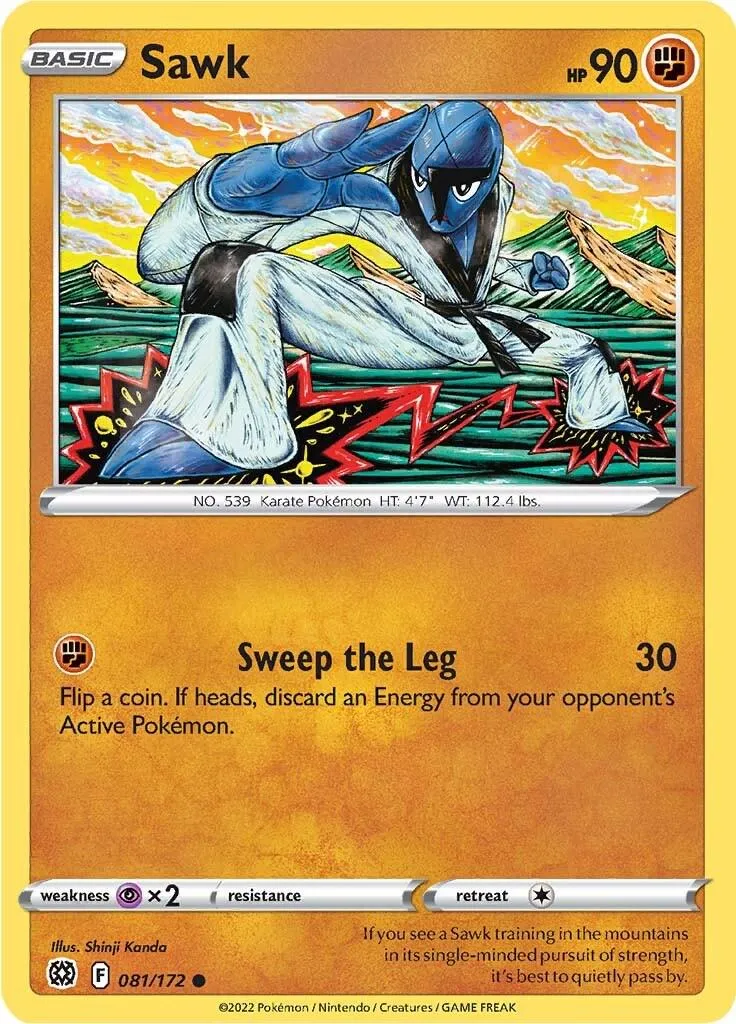
Kanda debuted in the Pokémon TCG during the Sword & Shield era with two commons in Brilliant Stars (February 2022): Sawk and Magmar. Neither was a chase card, but both introduced his unmistakable surrealist linework to the hobby.
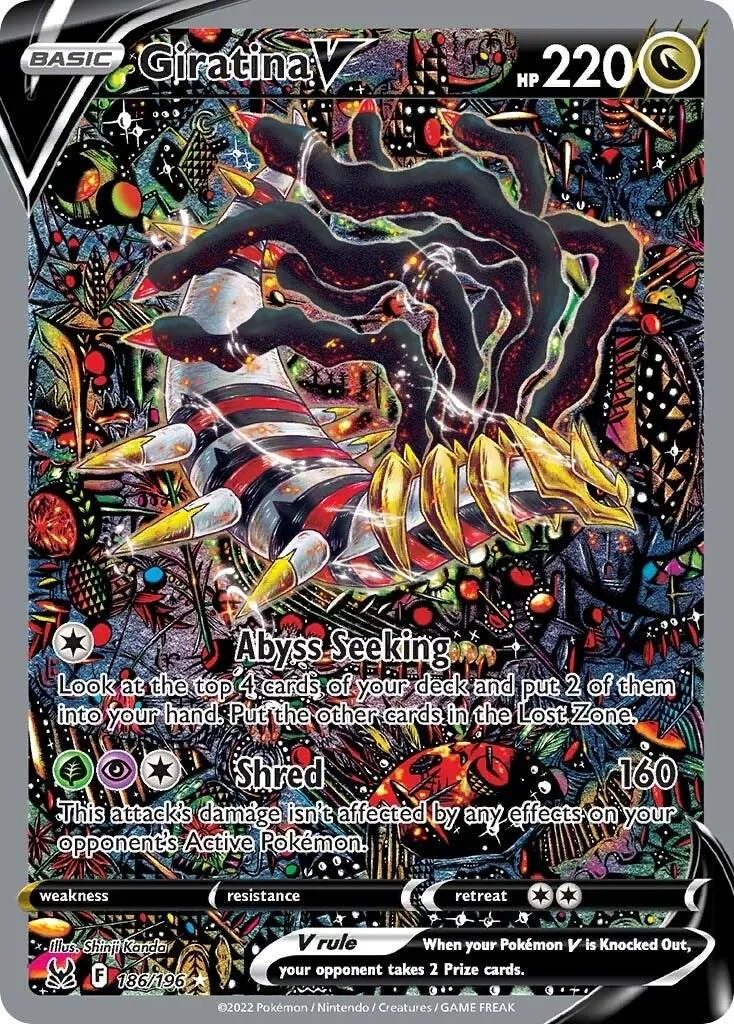
Seven months later, everything changed. Lost Origin (September 2022) contained the Giratina V Alternate Art (#186/196) — a mind-bending depiction of Origin Forme Giratina flying through the Distortion World, rendered with such intricate detail that it challenged the viewer’s ability to process the scene at a glance. It became one of the most iconic illustrations in TCG history and remains one of the most valuable cards of the entire Sword & Shield era.
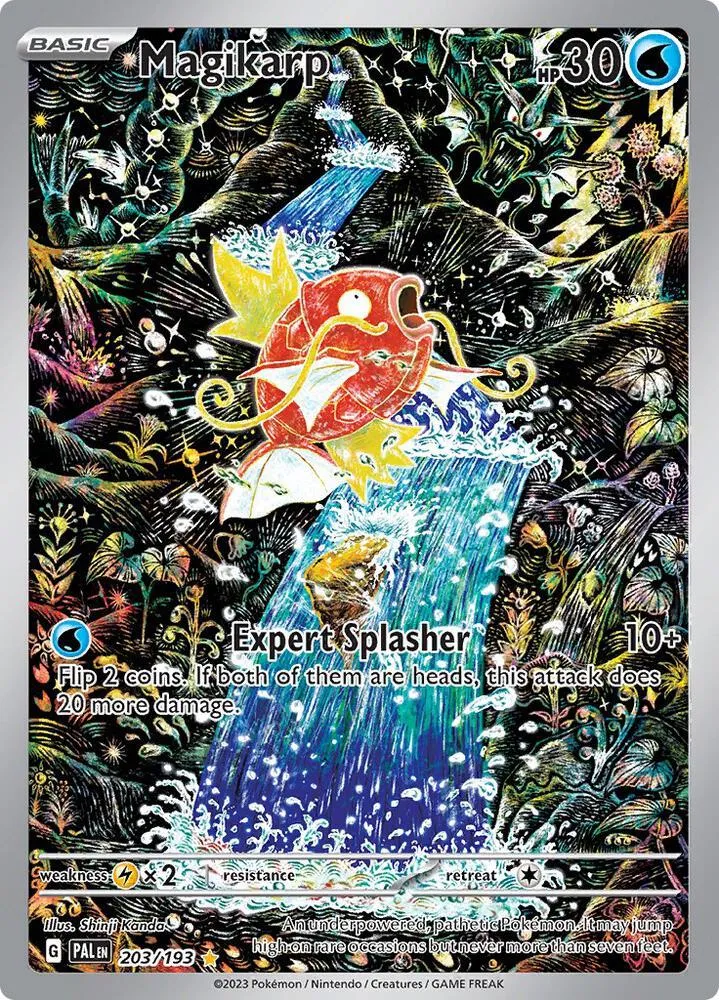
The ascent continued into Scarlet & Violet. His Magikarp Illustration Rare (#203/193) from Paldea Evolved (June 2023) turned a joke Pokémon into a modern grail — a fish battling upstream against a vibrant, swirling waterfall, drawn with Kanda’s signature obsessive detail. PSA 10 copies now sell for over $2,000.
| Set | Card | Rarity | Significance |
|---|---|---|---|
| Brilliant Stars | Sawk, Magmar | Common | TCG debut |
| Astral Radiance | Whiscash, Bronzong | Uncommon | First complex compositions |
| Lost Origin | Giratina V Alt Art | Alternate Art | Breakout card; SWSH-era icon |
| Paldea Evolved | Magikarp #203 | Illustration Rare | $2,000+ PSA 10; modern grail |
| Prismatic Evolutions | Roaring Moon ex #162 | Special Illustration Rare | Chase legendary; trending upward |
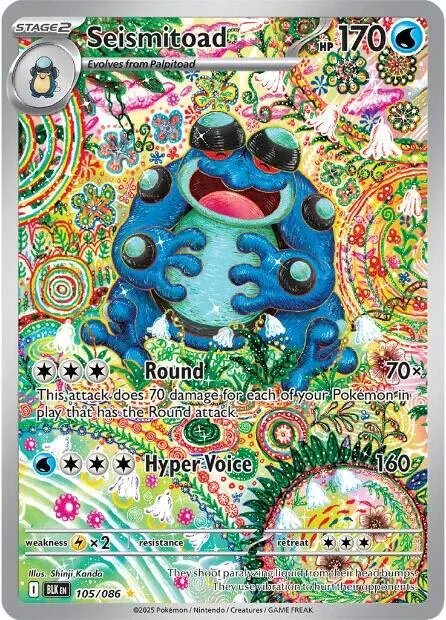
| Black Bolt | Seismitoad #105 | Illustration Rare | Triggered speculative bubble |
The “Shinji Tax”
In any normal market, a Magikarp card wouldn’t be worth $2,000. Magikarp isn’t Charizard. It isn’t Pikachu. But it’s drawn by Kanda, and that changes the equation entirely.
The “Shinji Tax” is the premium collectors pay for Kanda’s name on a card. It overrides the usual hierarchy where value follows Pokémon popularity. His Giratina V fluctuates between $2,250 and $3,500 at PSA 10. The Seismitoad spiked to over $2,000 at its peak. Even his Galarian Moltres promo commands attention despite being a mass-produced promotional card.
This has spawned a niche collector market around “sequential sets” — multiple Kanda cards graded consecutively by PSA, indicating they were submitted together as a curated collection. A sequential Japanese set of Roaring Moon, Magikarp, and Magneton has been listed at $750+.
The Shinji Tax isn’t just hype. It reflects a fundamental shift: in the modern TCG, the artist can matter more than the Pokémon.
The Seismitoad Controversy
The strangest chapter in Kanda’s market story came after Black Bolt (June 2025). His Seismitoad Illustration Rare depicted the Pokémon in a dense swampy environment. Shortly after release, rumours spread through investor groups that the foliage near Seismitoad’s shoulder formed the number “666”.
Speculation followed immediately: The Pokémon Company would be forced to ban the card or alter the artwork for Western markets, just as they’d altered the Magmortar card years earlier. The price spiked from $60 to over $200 within a week.
The theory was debunked. Botanical experts and rational collectors pointed out that the shapes were fiddlehead ferns — a common wetland plant and a frequent motif in Kanda’s nature-focused art. No ban materialised. But the price held, propped up by the Shinji Tax and the card’s difficult pull rates.
The episode is a case study in how Kanda’s complex, surrealist style invites pareidolia — and how market manipulators can leverage that to create artificial hype.
The Gallery Artist
Kanda isn’t just a card illustrator who does fine art on the side. It’s the other way round. He maintains a serious presence in the Kyoto and Tokyo gallery circuits, with regular solo exhibitions at KUNST ARZT, a contemporary art space in Kyoto that specialises in avant-garde work.
| Year | Exhibition | Focus |
|---|---|---|
| 2016 | Plastic ne. ~How plastic!~ | First solo show; early plastic-based art |
| 2018 | Images / Memory’s Fossils are Burning | Heat-shrinking as metaphor for memory |
| 2019 | Record of the Moon and the Stream | Metaphysical landscapes |
| 2022 | Drawing Auverbury | Urban landscapes and exotic cityscapes |
| 2024 | Exotic Yurei | Surrealist Japanese ghosts |
His original paintings use the same pen-and-pencil detail seen in his Pokémon cards, just at a larger scale. They sell out immediately. This gallery credibility creates a halo effect: card collectors feel they’re owning a miniature version of a gallery piece. And they’re not entirely wrong.
Kanda’s celebrity was cemented by his appearance at the 2025 Europe International Championships, where he held an autograph signing session. Queues stretched across the hall — a level of global recognition typically reserved for the original creators of the franchise.
Beyond Pokémon
Kanda has begun expanding into other major TCGs. He now has credits on Bandai’s One Piece TCG and Union Arena, where he’s illustrated high-rarity cards for the Tekken 7 set. There are also mentions of work in Magic: The Gathering, though these are typically overshadowed by his Pokémon output.
For collectors, this broadening matters. A wider collector base puts upward pressure on his foundational Pokémon cards — the Giratina, the Magikarp, the Seismitoad. As more people discover Kanda through other games, demand for his original hits only increases.
Card Gallery
What Comes Next
Kanda’s work in the Black Bolt and White Flare sets — the Unova-focused spiritual successors to Pokémon Card 151 — proved his surrealist style is a perfect match for Gen 5’s weirder, more complex designs. Those sets are now behind us, but the pipeline ahead is stacked.
In Japan, Ninja Spinner arrives March 13th featuring Mega Greninja ex, with rumoured follow-ups Abyss Eye (Mega Darkrai ex) and Storm Emeralda (Mega Rayquaza ex) on the horizon. On the English side, Perfect Order lands March 27th, followed by Chaos Rising on May 22nd. Whether Kanda has cards in any of these sets remains to be seen, but given his presence in nearly every major expansion since 2022, the odds are good.
The Pokémon TCG continues to pivot toward high-rarity, artist-centric sets. That’s Kanda’s territory. As long as that direction holds, the Shinji Tax isn’t going anywhere.
Kanda hasn’t just changed what a Pokémon card looks like. He’s changed what a Pokémon card can be worth — and why.
A closer look at the illustrators who shaped the Pokémon TCG — their backgrounds, techniques, and the cards that defined them.