The History of Full Art Cards
How a pair of legendary dragons in 2010 launched the most collectible card type in the Pokémon TCG.
The First Full Art Cards
Full art cards — where the illustration extends across the entire surface of the card rather than sitting in a bordered window — were introduced in the Black & White era. The very first full art cards were Reshiram (113/114) and Zekrom (114/114) from the Black & White base expansion.
In Japan, these debuted in Black Collection and White Collection in December 2010. The English release followed in April 2011. The artwork was produced by 5ban Graphics, a dedicated 3D computer graphics studio within Creatures Inc. that would go on to define the visual identity of full art cards for years.
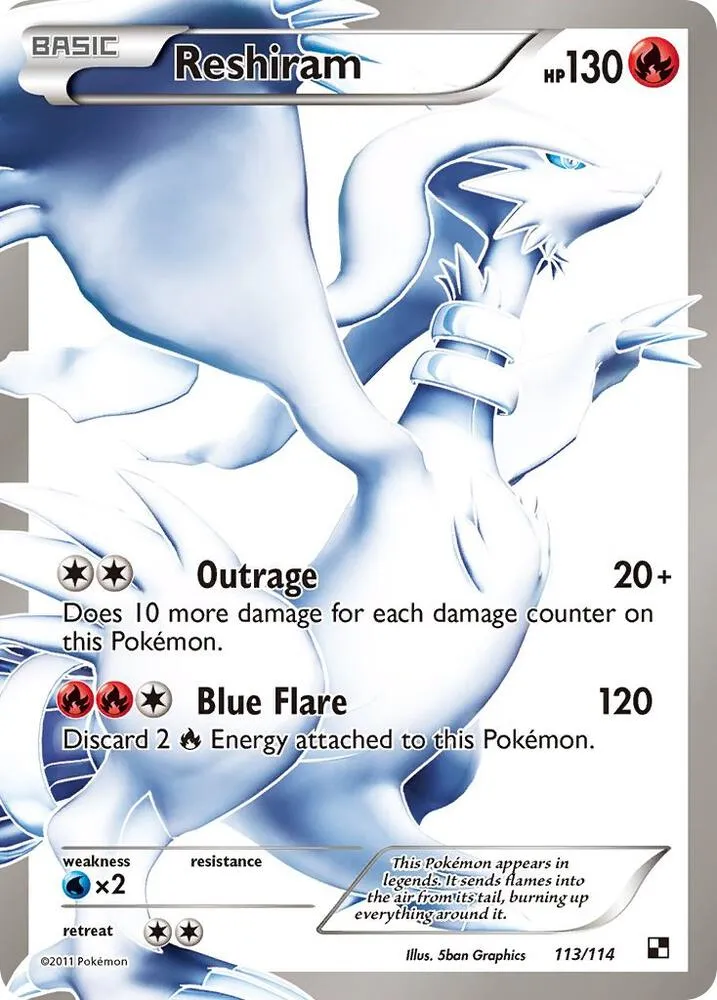

These two cards changed the trajectory of the TCG. For the first time, collectors had a reason to chase specific cards beyond gameplay power — the full art treatment made them feel premium. The 5ban Graphics CG style was bold and immediately recognisable, setting these apart from anything that had come before.
Both Reshiram and Zekrom have since been reimagined in the new Black Bolt and White Flare sets, featuring textured monochrome full art cards — a modern tribute to where it all started.
The First Full Art Trainers
It didn’t take long for the full art treatment to expand beyond Pokémon. The first ever full art Trainer card was N (101/101) from Noble Victories, released in November 2011. Illustrated by Ken Sugimori himself — the original designer of Pokémon — this card carries serious weight with collectors.


N at £110 is comfortably the most valuable full art Trainer from the early Black & White era. As the first of its kind and drawn by the franchise’s original artist, it’s the kind of card that gains significance over time rather than losing it.
The first full art female Trainer followed a year later: Bianca (147/149) from Boundaries Crossed in November 2012. That same set also introduced full art Cheren and full art Skyla, establishing the pattern of multiple full art Trainers per expansion that continues today.
Secret Rares: Another Black & White First
The Black & White era didn’t just introduce full arts. It was also the first era to include secret rare cards — cards numbered beyond the official set total. When you see a card numbered 114/113 or 147/146, that’s a secret rare, and the concept started here.
This layering of rarity — full arts, secret rares, and eventually full art secret rares — created the collectibility hierarchy that drives the modern TCG. Every chase card you open today traces its lineage back to this era.
Full Art Milestones
| Milestone | Card | Set | Date |
|---|---|---|---|
| First full art cards | Reshiram 113/114, Zekrom 114/114 | Black & White | Apr 2011 |
| First full art Trainer | N 101/101 | Noble Victories | Nov 2011 |
| First full art female Trainer | Bianca 147/149 | Boundaries Crossed | Nov 2012 |
| First secret rares | Various | Black & White era | 2011 |
Why It Matters
Before Black & White, Pokémon cards were collectible because of what they did in gameplay and which Pokémon was on them. Full arts changed that. They introduced the idea that how a card looks — the art treatment, the texture, the rarity symbol — could be just as important as what’s printed on it.
That shift led directly to the illustration rares, special art rares, and hyper rares that define collecting today. Every Scarlet & Violet chase card, every Illustration Rare you see on social media, every textured card you pay a premium for — it all started with Reshiram and Zekrom in a Black & White booster pack.
From two dragons in 2010 to the most sought-after card type in the hobby. Full arts didn’t just change the cards — they changed what it meant to collect them.