Pokémon Type Chart: Every Type Effectiveness Matchup
All 18 types and all 324 matchups in one grid, a calculator for any single or dual type, and the full list of abilities, moves and formats that ignore the chart entirely.
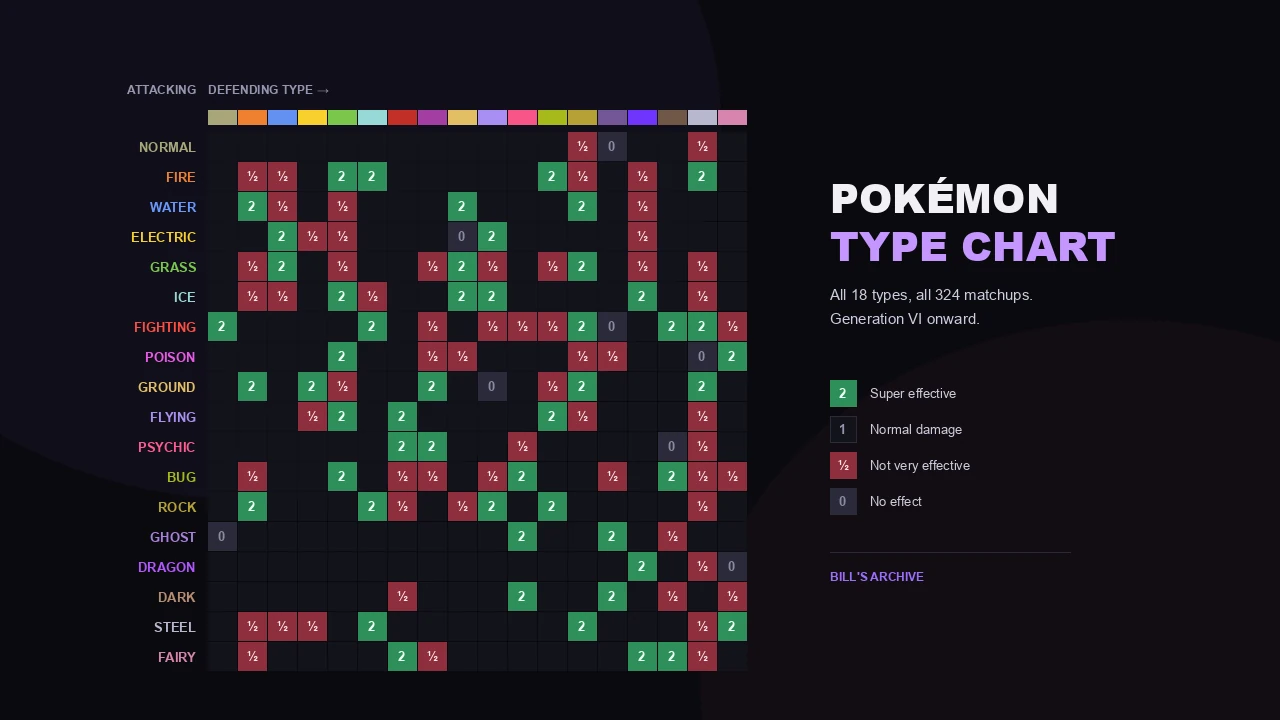
Every Pokémon has one or two types, and every damaging move has exactly one. When a move lands, the game compares the move's type against the defending Pokémon's type or types and multiplies the damage accordingly. That comparison is the type chart.
There are 18 types and 324 possible matchups between them. This page has the complete grid, a calculator for working out any type combination, a breakdown of each type on its own, and the exceptions that override the chart. The chart shown here is the one used by the main series from Generation VI (X and Y, 2013) onward. It has not changed since.
Current Chart
Matchups
No Damage
The Full Type Chart
Read across from an attacking type on the left to a defending type along the top. The cell where they meet is the multiplier. Empty cells are normal damage. Hover over any cell, or tap it on a phone, to see the matchup written out below the grid.
| ATKDEF | NormalNOR | FireFIR | WaterWAT | ElectricELE | GrassGRA | IceICE | FightingFIG | PoisonPOI | GroundGRO | FlyingFLY | PsychicPSY | BugBUG | RockROC | GhostGHO | DragonDRA | DarkDAR | SteelSTE | FairyFAI |
|---|---|---|---|---|---|---|---|---|---|---|---|---|---|---|---|---|---|---|
| Normal | ½ | 0 | ½ | |||||||||||||||
| Fire | ½ | ½ | 2× | 2× | 2× | ½ | ½ | 2× | ||||||||||
| Water | 2× | ½ | ½ | 2× | 2× | ½ | ||||||||||||
| Electric | 2× | ½ | ½ | 0 | 2× | ½ | ||||||||||||
| Grass | ½ | 2× | ½ | ½ | 2× | ½ | ½ | 2× | ½ | ½ | ||||||||
| Ice | ½ | ½ | 2× | ½ | 2× | 2× | 2× | ½ | ||||||||||
| Fighting | 2× | 2× | ½ | ½ | ½ | ½ | 2× | 0 | 2× | 2× | ½ | |||||||
| Poison | 2× | ½ | ½ | ½ | ½ | 0 | 2× | |||||||||||
| Ground | 2× | 2× | ½ | 2× | 0 | ½ | 2× | 2× | ||||||||||
| Flying | ½ | 2× | 2× | 2× | ½ | ½ | ||||||||||||
| Psychic | 2× | 2× | ½ | 0 | ½ | |||||||||||||
| Bug | ½ | 2× | ½ | ½ | ½ | 2× | ½ | 2× | ½ | ½ | ||||||||
| Rock | 2× | 2× | ½ | ½ | 2× | 2× | ½ | |||||||||||
| Ghost | 0 | 2× | 2× | ½ | ||||||||||||||
| Dragon | 2× | ½ | 0 | |||||||||||||||
| Dark | ½ | 2× | 2× | ½ | ½ | |||||||||||||
| Steel | ½ | ½ | ½ | 2× | 2× | ½ | 2× | |||||||||||
| Fairy | ½ | 2× | ½ | 2× | 2× | ½ |
Only four values appear anywhere on the chart: 2×, 1×, ½× and 0×. There is no 3× and no 1.5×. The larger multipliers that players talk about, such as a 4× weakness, only come from dual types, which are covered further down.
Type Matchup Calculator
Pick one or two types below to see everything that hits that combination hard, everything it shrugs off, and anything that cannot touch it at all. Leave the second slot on None for a single-type Pokémon.
How Dual Types Stack
When a Pokémon has two types, the move is checked against both and the two multipliers are multiplied together. Nothing is averaged and nothing is capped. This is where 4× weaknesses and quarter-damage resistances come from.
| Result | How It Happens | Example |
|---|---|---|
| 4× | Super effective against both types | An Ice move against a Dragon/Flying Pokémon. Ice is 2× on Dragon and 2× on Flying. |
| 2× | Super effective against one type, neutral against the other | A Fire move against a Grass/Poison Pokémon. Fire is 2× on Grass and 1× on Poison. |
| 1× | Neutral against both, or one weakness cancelled by one resistance | A Grass move against a Water/Flying Pokémon. Grass is 2× on Water and ½× on Flying, and the two cancel out. |
| ½× | Resisted by one type, neutral against the other | A Grass move against a Fire/Normal Pokémon. |
| ¼× | Resisted by both types | A Grass move against a Fire/Flying Pokémon. Grass is ½× on both. |
| 0× | Either type is immune, whatever the other one does | An Electric move against a Water/Ground Pokémon. Electric is 2× on Water but 0× on Ground, and zero wins. |
An immunity always overrides a weakness. There is no combination of types where a 0× can be cancelled out by a 2×, because anything multiplied by zero is zero. This is why Ground types are safe from Electric moves no matter what their second type is.
The Eight Immunities
Eight matchups on the chart deal no damage at all. These are worth memorising before anything else, because a move that does nothing costs a full turn.
| Move Type | Has No Effect On | Note |
|---|---|---|
| Normal | Ghost | Mutual: Ghost moves also do nothing to Normal types. |
| Fighting | Ghost | Ghost is the only type that walls Fighting outright. |
| Ghost | Normal | The other half of the Normal and Ghost standoff. |
| Electric | Ground | Ground is Electric's only clean answer. |
| Ground | Flying | Ground moves cannot reach an airborne target. |
| Poison | Steel | Steel cannot be poisoned by status either. |
| Psychic | Dark | Added in Generation II with the Dark type. |
| Dragon | Fairy | Added in Generation VI with the Fairy type. |
Only two of these run both ways. Normal and Ghost cannot damage each other at all, which is the one genuinely mutual standoff on the chart. Every other immunity is one-directional: Ground is immune to Electric moves, but Electric types take normal damage from Ground moves.
Every Type in Detail
Each card below covers one type twice over. The first half is what that type does when it is the move being used. The second half is what happens to a Pokémon of that type when it is being hit. Those two halves are not mirror images of each other, and confusing them is the most common mistake with the chart.
Normal
Fire
Water
Electric
Grass
Ice
Fighting
Poison
Ground
Flying
Psychic
Bug
Rock
Ghost
Dragon
Dark
Steel
Fairy
The Strongest and Weakest Types
Offence
Ground and Fighting are tied for the widest coverage, each hitting five types for double damage. Ground is the better of the two in practice: it is resisted by only Grass and Bug and walled by Flying, while Fighting moves are resisted by five separate types and blocked entirely by Ghost.
Normal is the only type in the game with no super-effective matchup at all. Normal moves hit two thirds of the chart for neutral damage, are resisted by Rock and Steel, and do nothing to Ghost. Dragon is close behind for a different reason: it is super effective against exactly one type, Dragon itself, and Fairy types take no damage from it.
Grass and Bug are the most resisted attacking types, each blunted by seven of the 18 types.
Defence
Steel is the strongest defensive type by a wide margin. It resists ten of the 18 types, takes nothing from Poison, and is weak to only Fire, Fighting and Ground. No other type resists more than six.
Grass and Rock are the most exposed, with five weaknesses each. At the other end, Normal and Electric each have exactly one weakness: Fighting and Ground respectively. Every type has at least one. There is no type that cannot be hit for super-effective damage by something.
| Record | Type | Detail |
|---|---|---|
| Most super-effective matchups | Ground, Fighting | Five each |
| Fewest super-effective matchups | Normal | None at all |
| Most resisted attacking type | Grass, Bug | Resisted by seven types each |
| Most resistances when defending | Steel | Ten resistances plus one immunity |
| Most weaknesses when defending | Grass, Rock | Five each |
| Fewest weaknesses when defending | Normal, Electric | One each |
| Most immunities when defending | Ghost | Immune to Normal and Fighting |
What Breaks the Chart
The chart is the default, not the final word. A long list of abilities, moves, items and formats change or ignore it. These are the ones that come up most often.
Abilities
- Levitate makes the holder immune to Ground moves regardless of its types.
- Flash Fire, Water Absorb, Volt Absorb, Sap Sipper, Lightning Rod, Storm Drain, Motor Drive and Dry Skin each convert one type into an immunity, usually with a bonus attached such as healing or a stat boost.
- Wonder Guard blocks every move that is not super effective. Only Shedinja has it.
- Filter, Solid Rock and Prism Armor reduce incoming super-effective damage.
- Tinted Lens doubles the damage of the holder's not-very-effective moves, cancelling out the resistance.
- Scrappy lets Normal and Fighting moves hit Ghost types.
- Delta Stream, the ability Mega Rayquaza brings with it, removes Flying's weaknesses while it is active.
Moves
- Freeze-Dry is an Ice move that is super effective against Water, which the chart otherwise resists.
- Flying Press is a Fighting move that also counts as Flying-type when effectiveness is worked out.
- Thousand Arrows is a Ground move that can hit Flying-type Pokémon.
- Foresight and Odor Sleuth strip a Ghost type's immunity to Normal and Fighting. Miracle Eye does the same for Dark against Psychic.
- Gravity and Smack Down ground airborne Pokémon so Ground moves connect.
- Roost removes the user's own Flying type for the rest of the turn, changing what it is weak to while it heals.
Items and formats
- Ring Target removes the holder's type immunities. Iron Ball grounds it.
- Terastallization, introduced in Scarlet and Violet, replaces a Pokémon's types with its Tera Type for the rest of the battle. Defensive matchups are recalculated from scratch against the new type.
- Inverse Battles, introduced in X and Y, flip the whole chart. Weaknesses become resistances, resistances become weaknesses, and immunities become super-effective hits.
- Pokémon GO keeps the same matchups but uses its own multipliers and has no true immunities. A matchup that deals zero damage in the main series is heavily reduced in GO rather than blocked.
How the Chart Has Changed
The chart has been revised twice in thirty years. Both revisions came with new types, and both changed matchups that already existed.
| Generation | Types | What Changed |
|---|---|---|
| I (1996) | 15 | The original chart. No Dark, Steel or Fairy. Ghost moves had no effect on Psychic types, which left Psychic with almost nothing to fear. |
| II (1999) | 17 | Dark and Steel added. Both blunt Psychic: Dark takes no damage from Psychic moves and Steel resists them. Ghost became 2× against Psychic. Bug against Poison dropped from 2× to ½×. Poison against Bug dropped from 2× to 1×. Ice against Fire dropped from 1× to ½×. |
| III–V | 17 | No changes to the chart. |
| VI (2013) | 18 | Fairy added, resisting Fighting, Bug and Dark, immune to Dragon, and super effective against Fighting, Dragon and Dark. Steel lost its resistances to Ghost and Dark at the same time. |
| VII–IX | 18 | No changes to the chart. Generation IX added Terastallization, which changes a Pokémon's types rather than the chart itself. |
Weakness and Resistance in the TCG
The Pokémon Trading Card Game does not use this chart. It uses a much smaller system printed on each card, in the bar along the bottom: one Weakness, and sometimes one Resistance. In the current era Weakness doubles the damage taken and Resistance, where a card has one, subtracts 30.
The TCG also runs on its own shorter list of Energy types, so the 18 video-game types are collapsed into far fewer. Bug Pokémon become Grass. Ice becomes Water. Ground and Rock become Fighting. Ghost becomes Psychic. Normal and Flying become Colorless. Electric, Dark and Steel are printed as Lightning, Darkness and Metal. A Fairy type existed in the TCG from the XY era and was retired during Sword & Shield.
For more on how cards themselves are laid out, the card anatomy guide labels every part of a modern card, including the Weakness and Resistance bar.
Common Questions
What type is best against Dragon?
Ice, Dragon and Fairy all hit Dragon types for double damage. Fairy is the safest choice of the three, because Dragon moves have no effect on Fairy types at all. Ice is the riskiest, since Ice is weak to a lot and many Dragon-type Pokémon carry a second type that resists it.
Which type has no weaknesses?
None. All 18 types can be hit for super-effective damage by something. Normal and Electric come closest with one weakness each, Fighting and Ground respectively.
What is super effective against Steel?
Fire, Fighting and Ground, and nothing else. Steel resists ten types and is immune to Poison, which makes those three the only way through it on the chart alone.
How much damage does a 4× weakness do?
Four times normal. It happens when a move is super effective against both halves of a dual type, so the two 2× multipliers stack. A Rock move against a Bug/Flying Pokémon is the classic case.
Does the type chart change between games?
Not in the main series since Generation VI. Pokémon GO uses the same matchups with different multipliers and no immunities. The TCG uses an entirely separate system. Spin-off titles vary and should not be assumed to match.
Is STAB the same as type effectiveness?
No. Same-Type Attack Bonus is a 1.5× multiplier that applies when a Pokémon uses a move matching one of its own types. It has nothing to do with the defender and stacks on top of whatever the chart says.