Pokémon Snap: A History of the Franchise
From the N64’s ZERO-ONE to the Switch’s NEO-ONE — how a pacifist photography sim became one of Pokémon’s most beloved spin-offs, the 22-year wait for a sequel, and what changed when it finally arrived.
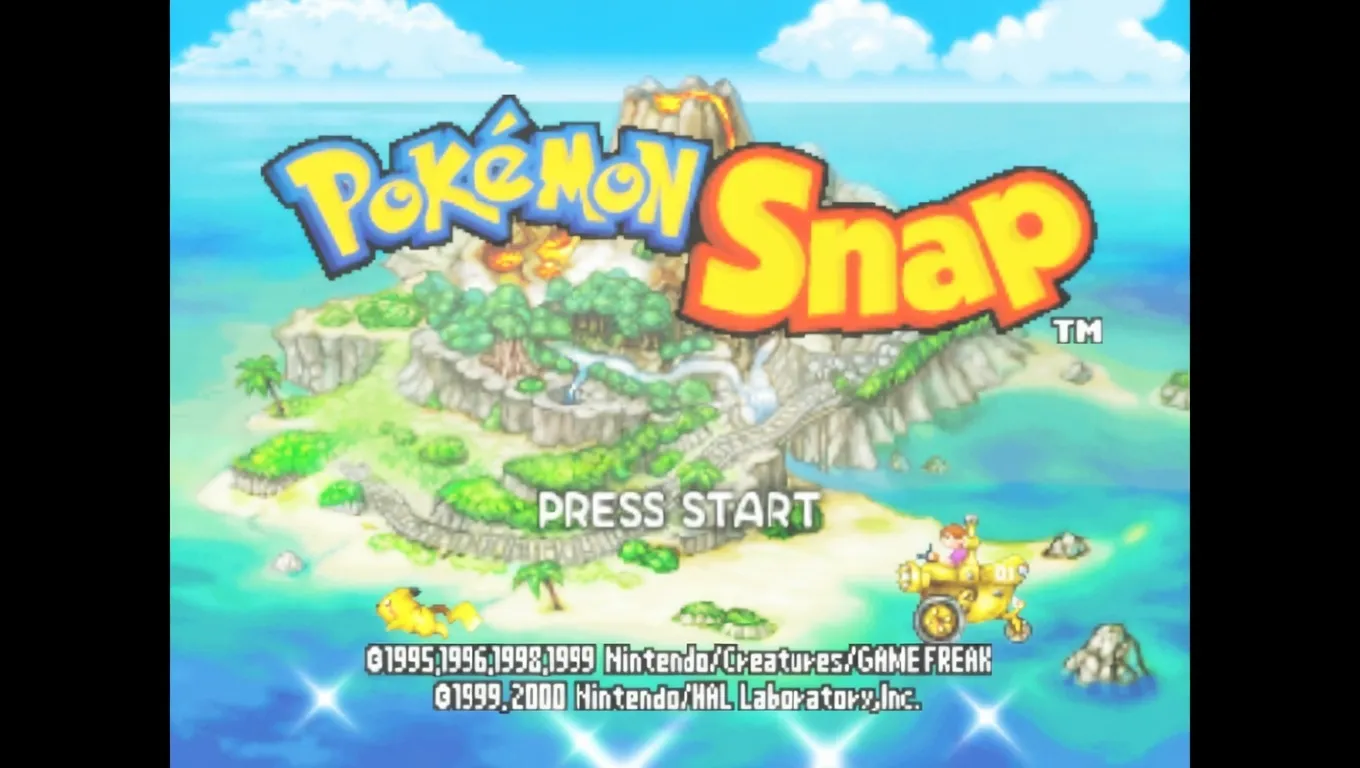
The Pacifist Rail Shooter
The Pokémon Snap series replaces the franchise’s signature capture-and-battle loop with a camera. Operating as a first-person, on-rails photography sim, players travel in an automated vehicle along predetermined paths, using items and environmental triggers to coax reactions from wild Pokémon and photograph them for scoring. No health bars, no fail states — just a virtual safari built around precision timing and score optimisation.
Two games span a 22-year gap: the 1999 N64 original developed by HAL Laboratory, and the 2021 Switch sequel by Bandai Namco Studios. Between them, the franchise sold over 6.3 million copies and transformed from a cult-classic puzzle game into a full ecological simulator.
The 1999 Original
Developed by HAL Laboratory with assistance from Pax Softonica, the original Pokémon Snap was published by Nintendo for the N64. It was initially built for the 64DD peripheral, but migrated to standard cartridge after the add-on’s commercial failure. The game featured a serene score by Ikuko Mimori, deliberately eschewing the high-tempo battle themes of the mainline RPGs.
Players assume the role of Todd Snap, commissioned by Professor Oak to photograph the inhabitants of Pokémon Island from inside the ZERO-ONE — an automated, amphibious buggy that cannot be stopped, braked, or reversed. This constant forward momentum transforms what looks like a nature sim into a high-pressure, memorisation-driven arcade shooter where the perfect shot is available for fractions of a second.
The game’s toolkit — Pokémon Food (apple bait), Pester Balls (stun/flush projectiles), the Poké Flute (auditory triggers), and the Dash Engine (speed boost) — created a dense web of environmental puzzles. Toss food near a riverbank to lure Slowpoke; wait for Shellder to bite its tail and trigger an on-camera evolution into Slowbro. Draw three Magnemite together and they magnetically fuse into Magneton. Knock a Charmeleon into a magma pool and force a dramatic evolution into Charizard.
Six hidden “Pokémon Signs” — natural formations resembling Pokémon silhouettes (Kingler Rock, Pinsir Shadow, Koffing Smoke, Cubone Tree, Mewtwo Constellation, Dugtrio Mountain) — unlock the final Rainbow Cloud stage and a climactic encounter with Mew.
New Pokémon Snap (2021)
After 22 years of fan petitions, Bandai Namco Studios (fresh off Pokkén Tournament) delivered New Pokémon Snap for the Switch, directed by Haruki Suzaki. Players explore the Lental region in the NEO-ONE hovercraft, investigating the “Illumina phenomenon” — a bioluminescent ecological mystery — under the guidance of Professor Mirror.
The core rail-shooter format is preserved — the NEO-ONE still can’t be stopped — but the toolkit is modernised: Fluffruit replaces apples, Illumina Orbs trigger bioluminescent reactions, the Melody Player replaces the Poké Flute, and a Scan radar highlights hidden creatures and branching paths. Late-game unlocks include Turbo Boost and Burst Mode for rapid-fire shooting.
The biggest structural change is the Research Level system. Repeatedly running courses accumulates Expedition Points, levelling each track from 1 to 3 (MAX). Higher levels fundamentally reshape the ecosystem — new spawns, new behaviours, and critically, new branching paths. A Pokémon that hides in brush at Level 1 might playfully approach the NEO-ONE at Level 3.
The Scoring Systems
Professor Oak’s 1999 rubric was rigid: Size (up to 1,000), Pose (1,200+), Special (1,300+), Same Pokémon bonus, and a Technique multiplier (x2 for perfect centring). A perfectly optimised Pikachu shot could reach 7,660 points through the formula (1300+1000+1250+280)×2.
New Pokémon Snap splits evaluation into two axes: Star Rating (what the Pokémon is doing) and Numerical Score (how good the photo looks). This fixes the original’s flaw where a blurry shot of a rare event could outscore a perfectly framed common behaviour.
Completing a species’ Photodex requires one photo from each star tier — meaning perfectly framed idle shots matter just as much as chaotic 4-star events. Scores above 4,000 earn the coveted Diamond medal, while aggregate totals of 40–50 million points unlock prestige Research Titles.
Commercial Performance
The original outsold Majora’s Mask on the N64. The sequel matched Xenoblade Chronicles 2 on Switch. For a pacifist photography sim, the numbers are remarkable.
UK launch sales for New Pokémon Snap were four times the original’s launch window. In the US, debut sales doubled the N64 version. The Switch sequel hit 2.07 million within two months and reached 2.74 million by December 2024.
The Version 2.0 Expansion
On 3 August 2021, a free update added 20 new Pokémon and three new areas (each with day/night variants, totalling six fresh tracks):
Reception & Legacy
| Outlet | Snap (1999) | New Snap (2021) |
|---|---|---|
| Metacritic | 77/100 | 79/100 |
| GameSpot | 8/10 | 8/10 |
| The Telegraph | — | 5/5 |
| EGM | — | 5/5 |
| Game Informer | — | 8.5/10 |
| The Guardian | — | 3/5 |
The 1999 original offered the first opportunity to see fully 3D Pokémon in natural habitats, complete with anime voice acting. Its puzzles were rigid and gamified — a consequence of N64 cartridge limitations — but inventive enough to earn cult status over two decades. New Pokémon Snap transitioned the formula into a breathing ecological simulator, replacing forced-evolution logic puzzles with patient, naturalistic observation across dynamic Research Levels and 100+ Research Requests.
Combined lifetime sales of 6.37 million units across both titles prove that the global appetite for relaxing, non-violent, observation-based games remains exceptionally strong — and that Pokémon’s world-building extends far beyond the battle system.