Last updated · prices collected
Base Set set overview
Base Set is the first expansion of the English Pokémon Trading Card Game. Wizards of the Coast released it on 9 January 1999, more than two years after its Japanese counterpart, Expansion Pack, opened the Pokémon Card Game in October 1996. The set has 102 cards and features only Generation I Pokémon from Pokémon Red, Blue and Green, alongside 26 Trainers and 7 Energy cards.
The list is ordered by card type, then by rarity, then alphabetically: the 16 Holo Rares come first, from Alakazam (001/102) to Zapdos (016/102), then the Rares, Uncommons and Commons, the Trainers from Clefairy Doll (070/102) and the Energy cards from Double Colorless Energy (096/102). It is the set that introduced Charizard, Blastoise and Venusaur to English players, and the three starters' final forms appear on its three booster pack wrappers.
Base Set was printed several times, and the runs are what collectors sort it by. The first run carries the 1st Edition stamp; a second run, known as Shadowless, has no stamp and no drop shadow on the art box; the Unlimited run added the shadow and bolder text; and a late fourth print changed the copyright line to 1999-2000. The quick facts below summarise how to tell them apart, and each card in the list shows its price for each printing where TCGplayer has one.
- 102Cards
- 69Pokémon
- 26Trainers
- 7Energy
- 4Illustrators
Set facts
- Released
- 9 January 1999 (English)
- Cards
- 102: 69 Pokémon, 26 Trainers, 7 Energy
- Holo Rares
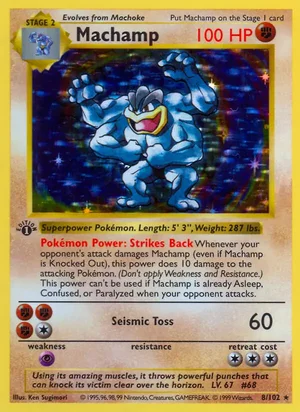
- 16, numbered 1 to 16; 15 in booster packs (Machamp came in starter sets instead)
- Printings
- 1st Edition (Shadowless), Shadowless, Unlimited (©1999), 4th print (©1999-2000)
- Edition mark
- Black “Edition 1” stamp at the left edge under the art box; 1st Edition holos have thin and thick stamp variants, which differ in the width of the “1”
- Booster pack
- 11 cards, with at least one Rare, which can be a Holo Rare; three wrapper artworks: Charizard, Blastoise and Venusaur
- Booster box
- 36 packs
- Set symbol
- None: Base Set cards carry no expansion symbol, unlike its reprints
- Japanese source
- Expansion Pack, 20 October 1996
- Error cards
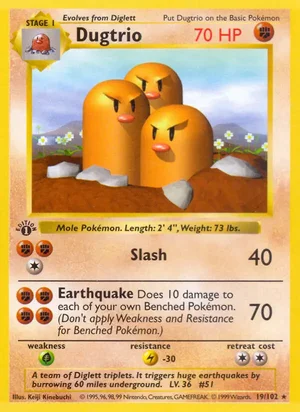
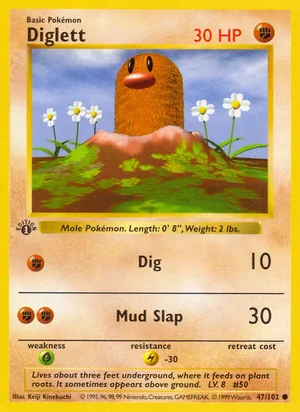
- Blastoise printed without the word “Stage”, Shadowless Ninetales missing its attack damage, Beedrill’s “D.efending” typo, Diglett with its attack Energy symbols turned 90 degrees
Base Set chase cards
The six cards below are the most expensive singles in the set on 4 October 2026, ranked by TCGplayer's main listing for each card, which for Base Set is the Unlimited print. The most expensive of all on that date was Charizard (004/102, Holo Rare). The headline card is the holo Charizard (004/102) by Mitsuhiro Arita, whose Fire Spin attack did 100 damage; collectors also chase the other two starter evolutions, Blastoise (002/102) by Ken Sugimori and Venusaur (015/102) by Arita. Outside the holos, the common Pikachu (058/102) has a red-cheeked variant in the 1st Edition and Shadowless runs. Tap a card to jump to it in the list, where the line under its name gives the 1st Edition and Shadowless prices next to Unlimited.
Base Set card list
Every card in the set is below in set-number order, with its rarity, illustrator and market price. The set has 16 Holo Rares, 16 Rares (six Pokémon and ten Trainers), 32 Uncommons and 38 Commons; the 38 include the six Basic Energy cards, which carry no rarity symbol on the card but are listed as Common in our data. Machamp, card 8, shows no price because our data has no listing for it: it was not in booster packs. The main price on each card is TCGplayer's Unlimited listing; the line under it adds 1st Edition and Shadowless prices where TCGplayer has them, so check the printing of your copy before you price it. Search by name, number, artist or rarity, or narrow the list with the type, rarity and price chips. The Own button marks a card as collected and saves the mark in your browser only.
No cards match. Clear the search or pick a different chip.
Base Set card prices
Market prices in US dollars, collected on 4 October 2026, with pounds at that day's rate (1 USD = 0.756 GBP). They are a snapshot, not live quotes. The bars show each card's price against the most expensive card in the set. The buy links are affiliate links and Bill's Archive earns a commission on qualifying purchases at no extra cost to you.
- $2,165.41£1,637.93One of every card
- 52%In the top two cards alone
- 18Cards at $10 or more
- 72Cards at $1 or more
- 29Bulk cards under $1
Prices by printing
| Printing | Cards priced | All priced cards | Top card in this printing |
|---|---|---|---|
| 1st Edition Holofoil | 9 | $5,296.90 | Blastoise 002/102 · $1,300.00 |
| 1st Edition | 86 | $5,183.86 | Bulbasaur 044/102 · $313.19 |
| Shadowless Holofoil | 14 | $5,594.70 | Charizard 004/102 · $2,257.87 |
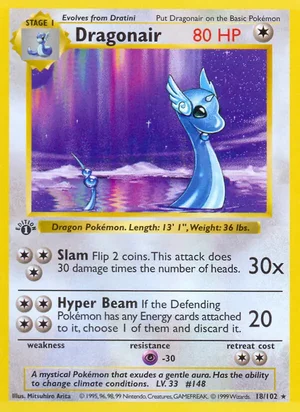
| Shadowless | 86 | $919.27 | Dragonair 018/102 · $57.68 |
| Unlimited Holofoil | 15 | $1,943.19 | Charizard 004/102 · $944.53 |
| Unlimited | 86 | $256.46 | Dragonair 018/102 · $18.32 |
TCGplayer market prices in US dollars by printing, from tcgcsv.com, collected on 4 October 2026. The headline price on each card is TCGplayer’s main listing for that card; the line under the card name splits it by printing. Holo and non-holo prints have their own rows. Rare vintage holos sell infrequently, so their market prices can lag behind recent sales.
The 15 most expensive singles
- 1
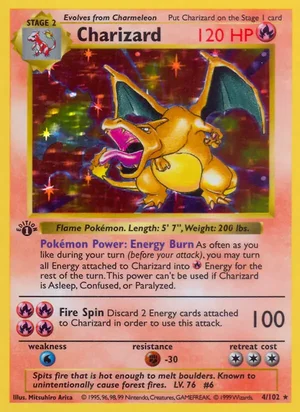 Charizard004/102 · H · Mitsuhiro Arita$910.75£688.90TCGplayer
 - 2
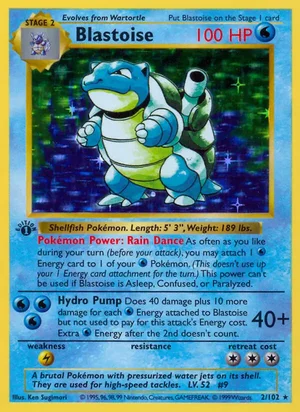 Blastoise002/102 · H · Ken Sugimori$223.23£168.85TCGplayer
 - 3
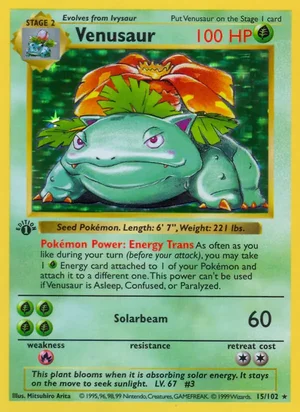 Venusaur015/102 · H · Mitsuhiro Arita$169.95£128.55TCGplayer
 - 4
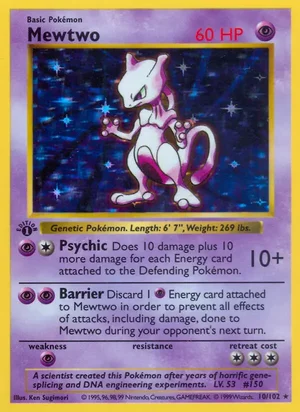 Mewtwo010/102 · H · Ken Sugimori$91.06£68.88TCGplayer
 - 5
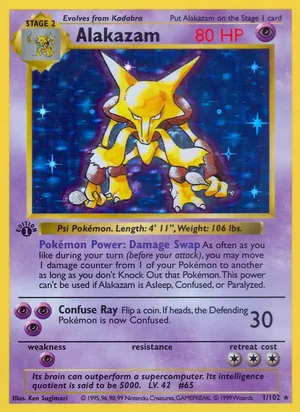 Alakazam001/102 · H · Ken Sugimori$69.41£52.50TCGplayer
 - 6
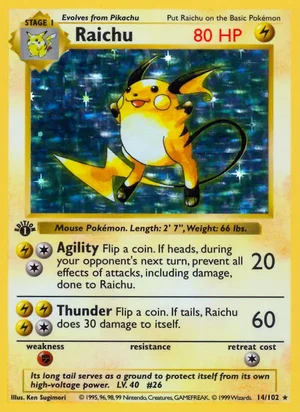 Raichu014/102 · H · Ken Sugimori$65.54£49.57TCGplayer
 - 7
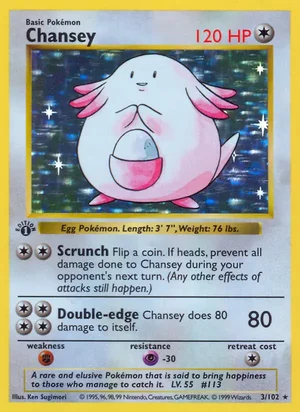 Chansey003/102 · H · Ken Sugimori$57.28£43.33TCGplayer
 - 8
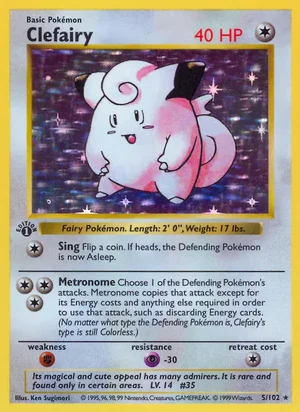 Clefairy005/102 · H · Ken Sugimori$52.79£39.93TCGplayer
 - 9
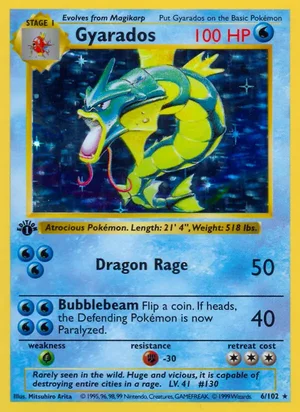 Gyarados006/102 · H · Mitsuhiro Arita$47.55£35.97TCGplayer
 - 10
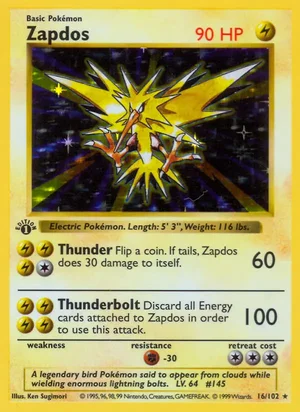 Zapdos016/102 · H · Ken Sugimori$45.17£34.17TCGplayer
 - 11
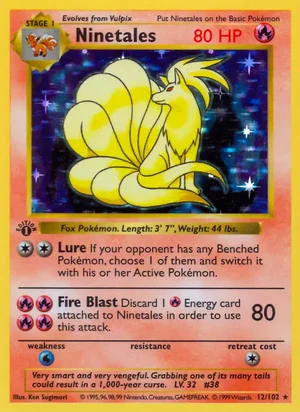 Ninetales012/102 · H · Ken Sugimori$41.96£31.74TCGplayer
 - 12
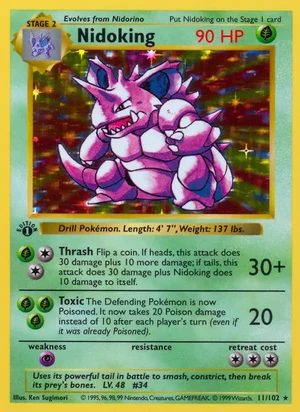 Nidoking011/102 · H · Ken Sugimori$38.78£29.33TCGplayer
 - 13
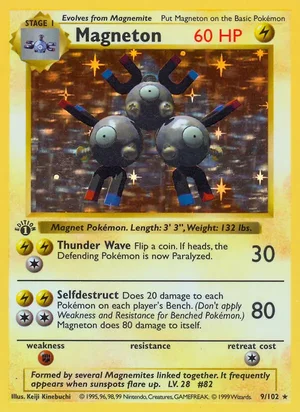 Magneton009/102 · H · Keiji Kinebuchi$37.08£28.05TCGplayer
 - 14
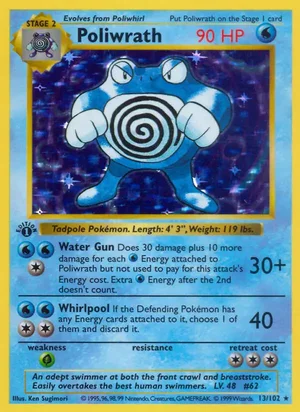 Poliwrath013/102 · H · Ken Sugimori$35.79£27.07TCGplayer
 - 15
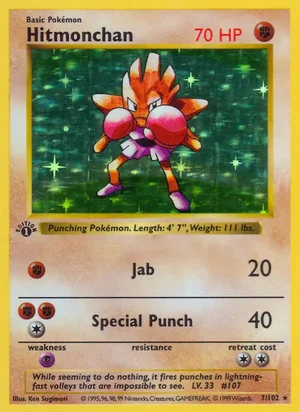 Hitmonchan007/102 · H · Ken Sugimori$20.48£15.49TCGplayer
Base Set illustrators
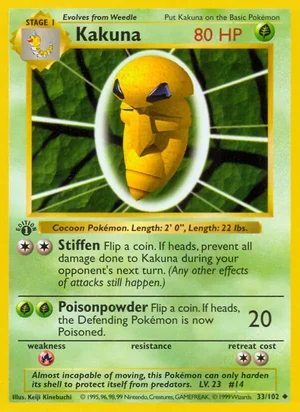
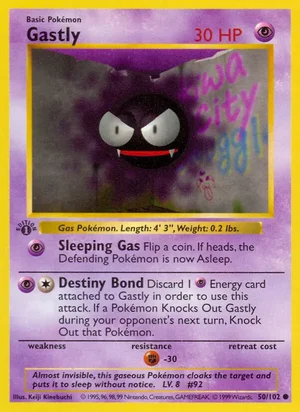
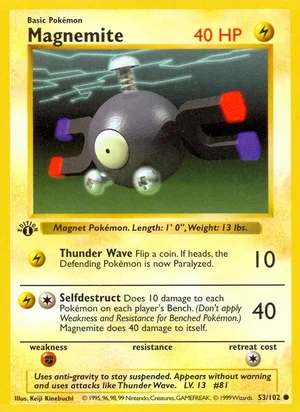
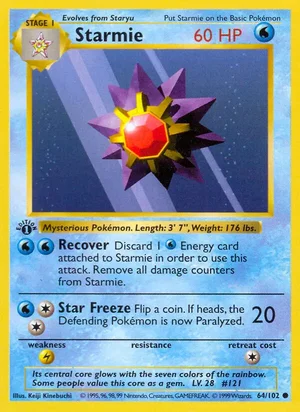
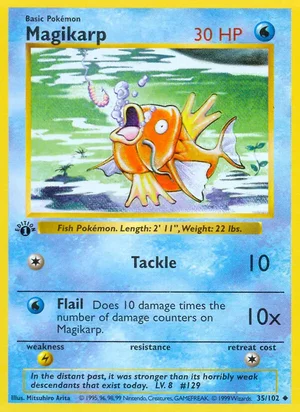
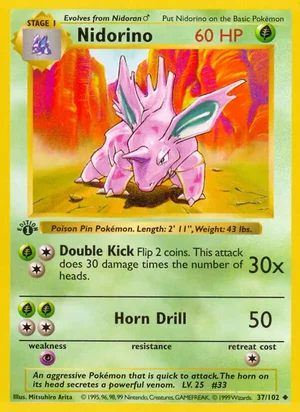
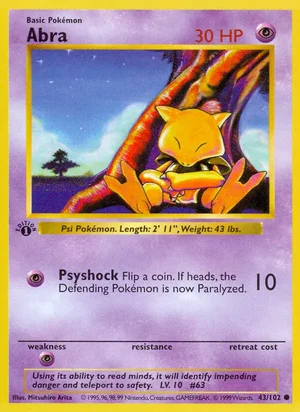
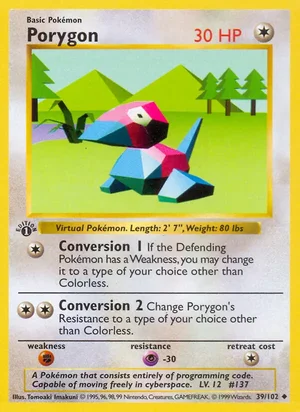
4 illustrators are credited across the set. Ken Sugimori has the most credits, among them Blastoise, Mewtwo, Alakazam, Raichu, Zapdos and the Professor Oak and Bill Trainers. Mitsuhiro Arita drew Charizard, Venusaur and Gyarados, the Dragonair Rare, Pikachu and the Charmander, Squirtle and Bulbasaur Commons, and he also painted the artwork for the Japanese Expansion Pack wrapper. Keiji Kinebuchi is credited with Magneton and the item Trainers such as Computer Search, and Tomoaki Imakuni with Porygon (039/102). Each tile leads with the artist's highest-value card in the set; the name links to their entry in the illustrator database.
Show all 4 illustrators
Japanese source: Expansion Pack
 Japanese source setExpansion PackReleased 20 October 1996 · 102 cards→
Expansion Pack (拡張パック) released in Japan on 20 October 1996 with the same 102 cards. Every Japanese card exists with and without a rarity symbol. The copies without one are believed to be the earlier print, because they contain errors fixed later, such as Venusaur numbered as Pokémon #68 instead of #3; collectors call it the No Rarity print. The two releases order their cards differently: the English set by card type, rarity and then name, the Japanese set by type, rarity and Pokédex number, with Trainers and Energy last. Some card text differs too: the English Charizard's Energy Burn follows a later Japanese wording, not the original Expansion Pack text. Japan had no 1st Edition runs at the time; Wizards of the Coast used the stamp for English and European releases from Base Set onwards.
Base Set products and sealed prices
Base Set was sold in booster packs and 36-pack booster boxes, in the 2-Player Starter Set and in four Theme Decks, which came out on the same day as the set. The 2-Player Starter Set holds 61 cards: two 30-card half decks, one built around Fighting Pokémon and one around Fire Pokémon, plus the holo Machamp, with a rulebook, damage counters and a card list but no coin. Each Theme Deck has 60 cards, damage counters, a coin, a rulebook and a card list, and one Holo Rare: Overgrowth (Grass and Water) has Gyarados, Zap! (Lightning and Psychic) has Mewtwo, Brushfire (Fire and Grass) has Ninetales and Blackout (Water and Fighting) has Hitmonchan. TCGplayer lists all four Theme Decks under one name, so the price shown is for one of them. Sealed prices are market prices from the same snapshot as the singles, and thin listings move them a long way.
 No photo yet
Booster Box
36 booster packs; TCGplayer lists this box as the Revised Unlimited Edition
No photo yetBooster Pack
11 cards, with a Charizard, Blastoise or Venusaur wrapper; TCGplayer's Revised Unlimited Edition listing
No photo yet2-Player Starter Set
61 cards: two 30-card half decks and a holo Machamp, with rulebook and damage counters; TCGplayer's reprint-run listing
No photo yetTheme Deck
60-card deck with one Holo Rare, a coin and damage counters: Overgrowth, Zap!, Brushfire or Blackout
Collector's notes
Telling the print runs apart
On Pokémon cards, look at the art box first: 1st Edition and Shadowless cards have no drop shadow on it and print the HP and attack text thinner than Unlimited cards do. A 1st Edition card adds the black "Edition 1" stamp at the left under the art box. Trainers and Energy have no art-box shadow, so check the copyright line instead: Bulbapedia notes that the Shadowless run reads "© 1995, 96, 98, 99 Nintendo" where Unlimited leaves off the 99. The fourth print copies Unlimited except for a 1999-2000 copyright date; some collectors call it the UK print, which is collector shorthand rather than an official name. The printing line under each card and the Prices by printing table show how far apart the 1st Edition, Shadowless and Unlimited prices are.
Machamp is a starter-set card
Machamp is the only Holo Rare not found in booster packs. Bulbapedia records it as printed commercially only with the 1st Edition stamp, in the 2-Player Starter Set: the first print of the starter set had a Shadowless 1st Edition Machamp and the second a 1st Edition Machamp with the shadow. A non-holo copy without the stamp came in Trainer Deck A, given to early Pokémon Leagues before the US launch, and a 1st Edition Cosmos holo version came in the later 2-Player CD-ROM Starter Set. A complete Base Set therefore needs a starter-set card as well as packs.
Red-cheeked Pikachu and other variants
Pikachu (058/102) was first printed with red cheeks, then changed to the yellow of the Japanese card. Bulbapedia estimates the split at about half and half in the 1st Edition and Shadowless runs, while Unlimited copies are all yellow, which makes red cheeks the variant to look for. Both versions also exist with a gold E3 stamp, and the yellow-cheeked card with a PokéTour 1999 stamp from Australia. Bulbapedia also lists a Raichu (014/102) with a Prerelease stamp, a misprint from the Jungle prerelease Clefable sheets that Wizards staff denied for years before confirming it existed.
Reprints share the art
Charizard, Blastoise and Venusaur were all reprinted in Base Set 2, Charizard, Venusaur and Machamp again in Legendary Collection, and Charizard, Blastoise, Venusaur and Imposter Professor Oak in the Celebrations Classic Collection. Charizard and Pikachu return in the 30th Celebration Classic Collection. The Base Set 2 and Legendary Collection reprints carry their own set symbols and numbers, and the Celebrations reprints a 25th Anniversary logo, while the Base Set originals have no set symbol.
More Original era set guides
Every English set of the Original era in release order.
- Base Set9 January 1999 · 102 cards
- Jungle16 June 1999 · 64 cards
- Fossil10 October 1999 · 62 cards
- Base Set 224 February 2000 · 130 cards
- Team Rocket24 April 2000 · 83 cards
- Gym Heroes14 August 2000 · 132 cards
- Gym Challenge16 October 2000 · 132 cards
Base Set FAQ
When did Base Set come out?
The English Base Set released on 9 January 1999, with its four Theme Decks on the same day. The Japanese version, Expansion Pack, came out on 20 October 1996.
How many cards are in Base Set?
102 cards: 69 Pokémon, 26 Trainers and 7 Energy. There are 16 Holo Rares, but only 15 came in booster packs; Machamp came in the 2-Player Starter Set instead.
What is the most valuable Base Set card?
By market price on 4 October 2026, Charizard (004/102, Holo Rare) at $910.75 (£688.90). That ranking uses TCGplayer's main listing, which for Base Set is the Unlimited print. The set's headline card is the holo Charizard (004/102) by Mitsuhiro Arita. 1st Edition and Shadowless copies sell separately; the line under each card and the Prices by printing table show them. The prices table on this page shows the top 15.
How do I tell 1st Edition, Shadowless and Unlimited apart?
A 1st Edition card has the black "Edition 1" stamp at the left under the art box. Shadowless cards have no stamp and no drop shadow on the right of the art box, and thinner HP and attack text. Unlimited cards have the shadow and bolder text, and the fourth print has a 1999-2000 copyright date.
Does Base Set have a set symbol?
No. Base Set cards have no expansion symbol, which is the easiest way to tell them from the Base Set 2, Legendary Collection and Celebrations reprints, which all carry a symbol or logo.
What is a red cheek Pikachu?
The first version of Pikachu (058/102), with red cheeks instead of yellow. It appears in the 1st Edition and Shadowless runs, roughly half of those Pikachu by Bulbapedia's estimate, but not in Unlimited.
Where do the prices on this page come from?
TCGplayer market prices for the US singles market, collected on the date shown above the prices table and converted to pounds at that day's exchange rate. The main price on each card is TCGplayer's Unlimited listing; the line under it and the Prices by printing table add 1st Edition and Shadowless prices from TCGplayer through tcgcsv.com, in US dollars. Graded copies are not included. They are a snapshot and will drift; the buy links show a live figure.