Last updated · prices collected
Aquapolis set overview
Aquapolis is the second main expansion of the e-Card series, released in English on 15 January 2003 by Wizards of the Coast. It sits between Expedition Base Set and Skyridge, the last set Wizards released before its licence passed to The Pokémon Company International in October 2003. The official blurb billed it, at 186 cards, as "the largest set ever".
That 186 needs unpacking. The main list runs 1/147 to 147/147. Three Crystal Pokémon follow as secret rares, 148/147 to 150/147. Thirty-two holofoil Rares carry their own numbers, H1/H32 to H32/H32. And four cards were printed twice, as 'a' and 'b' versions that differ only in their e-Reader data. Serebii notes that Aquapolis was the first set to number its holos apart from the main list, so a reverse holo of a Rare could not be confused with the holo of the same card.
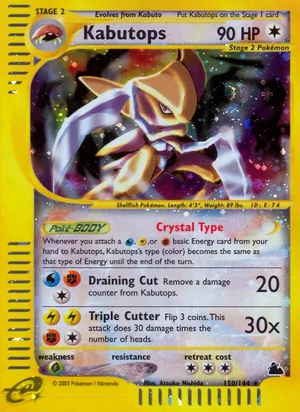
Aquapolis introduced Crystal Pokémon. They are Colorless, but their Crystal Type Poké-Body changes their type to match a basic Energy card attached from the hand, for that turn. The card backgrounds highlight the three Energy types each Crystal card works with. The Trainers include eight Technical Machines, the Cube 01 cards, one for each of eight types, alongside Supporters and four Stadiums, and the set adds the special Energy cards Crystal, Boost and Warp Energy.
Like every e-Card set, the cards carry Dot Code strips that the Nintendo e-Reader could scan for Pokédex entries, mini-games and hidden attacks. The English set combines two Japanese expansions, The Town on No Map and Wind from the Sea.
- 186Cards
- 3Secret rares
- 156Pokémon
- 24Trainers
- 6Energy
- 32Illustrators
Set facts
- Release date
- 15 January 2003 (English); the Japanese sources came out on 8 March and 24 May 2002
- Publisher
- Wizards of the Coast, which lost the Pokémon licence later in 2003; Skyridge was its last set
- Card count
- 186: 147 numbered cards, 3 Crystal Pokémon secret rares (148/147 to 150/147), 32 holos numbered H1/H32 to H32/H32, and 4 extra a/b prints
- a/b prints
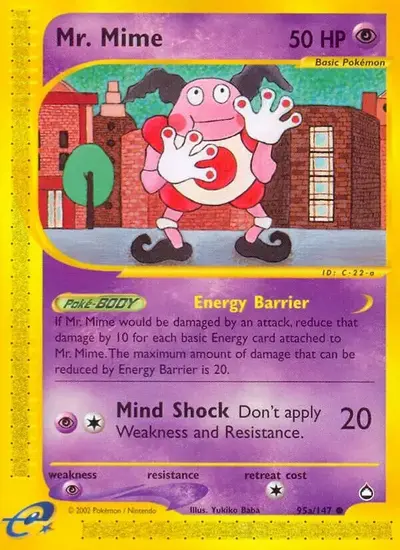
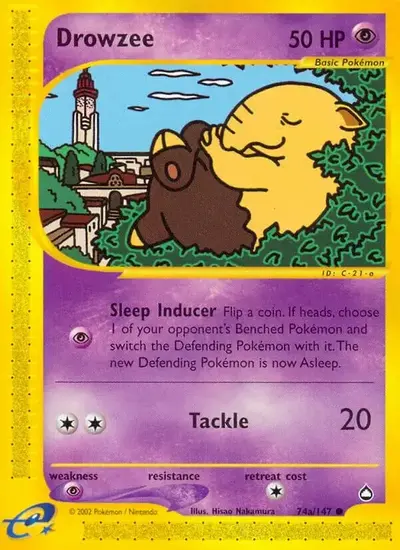
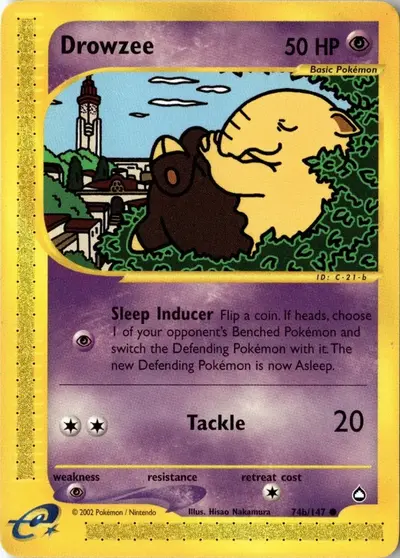
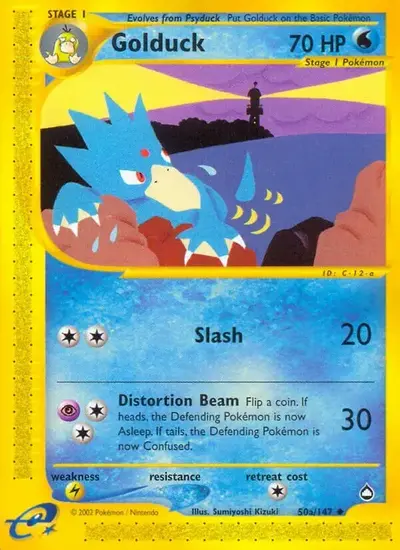
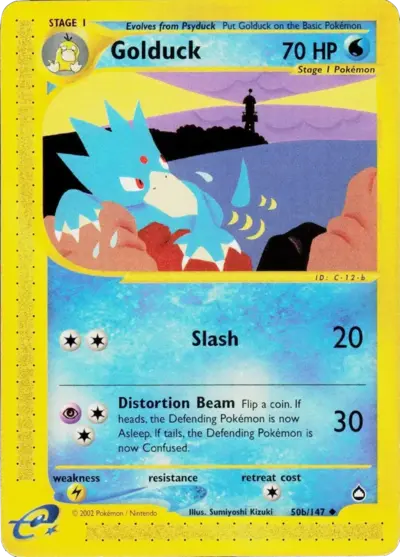
- Golduck 50a/50b, Drowzee 74a/74b, Mr. Mime 95a/95b and Porygon 103a/103b: identical cards with different e-Reader Dot Code data
- Booster pack
- 9 cards, one of them a reverse holo; pack art shows Arcanine, Scizor, Entei or Tyranitar
- Reverse holos
- Every card numbered 1 to 147, including the a/b prints; the H holos and Crystal cards have none
- Theme decks
- Rock Garden (Fighting and Grass) and Abyss (Fire and Water)
- Japanese sources
- The Town on No Map (92 cards) and Wind from the Sea (90 cards)
- Box toppers
- Oversized reverse holo Entei, Espeon, Scizor and Suicune (5/12 to 8/12 of the e-Card Box Topper series), packed in booster boxes
- e-Reader
- Cards carry Dot Code strips for the Nintendo e-Reader
Aquapolis chase cards
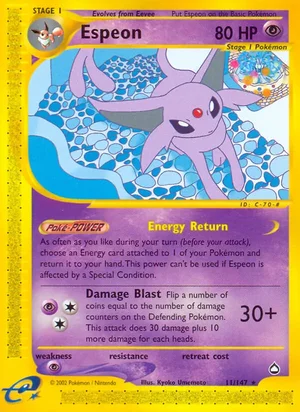
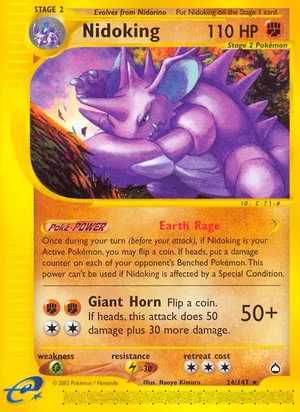
The six cards below are the most expensive singles in the set by market price on 4 October 2026. The most expensive of all on that date was Lugia (149/147, Secret Rare). The set's headline card is Crystal Lugia by Naoyo Kimura, one of only three Crystal Pokémon in Aquapolis: a Basic Pokémon whose type becomes Fire, Water or Psychic when you attach that basic Energy from your hand. The other two Crystal cards are Kingdra (148/147) by Mikio Menjo and Nidoking (150/147) by Hironobu Yoshida. The H holos include Suicune H25/H32, Entei H8/H32, Umbreon H29/H32 and Espeon H9/H32, and Entei, Espeon, Scizor and Suicune were also the set's oversized booster box toppers. Tap a card to jump to it in the list.
Aquapolis card list
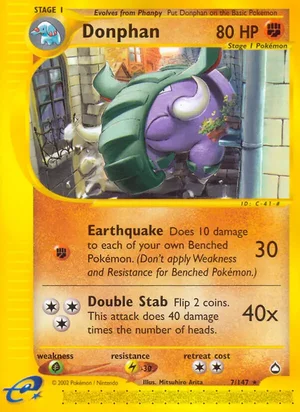
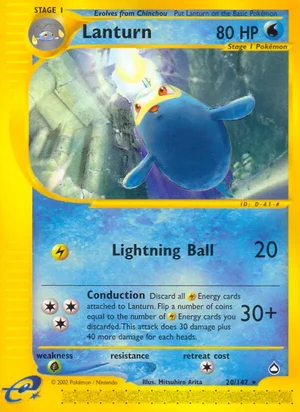
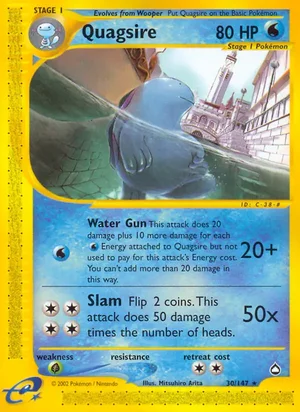
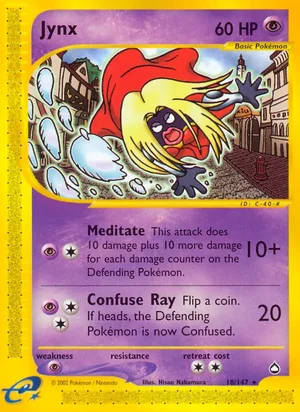
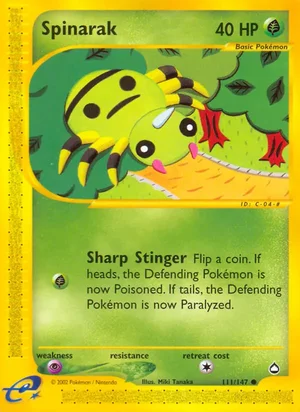
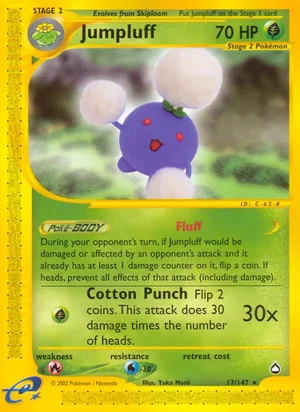
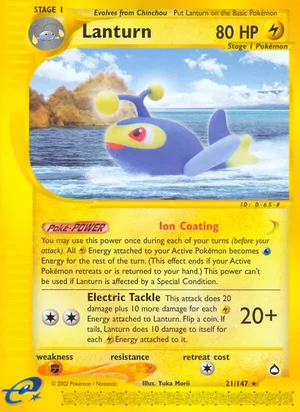
Every card in the set is below in set-number order, with its rarity, illustrator and market price. Cards 1 to 44 are the Rare Pokémon, 45 to 66 the Uncommon Pokémon and 67 to 117 the Common Pokémon. Trainers run from Apricorn Forest (118/147) to Weakness Guard (141/147), and the six Energy cards from Darkness Energy (142/147) to Warp Energy (147/147). The Crystal Pokémon come next, then the H1/H32 to H32/H32 holos at the end. Thirty-two of the 44 Rare Pokémon have an H holo with the same card text and artwork; the other twelve, such as Donphan, Elekid, Jynx, Quagsire and Slowbro, exist only as a regular print and a reverse holo. The headline price on each card is TCGplayer's main listing: the regular print, or the holo for the H and Crystal cards. The line under the name gives the regular and reverse holo prices side by side where TCGplayer has both, and the Prices by printing table compares the holo, regular and reverse holo prints. TCGplayer has no reverse holo listing for Quagsire (30/147) or Hitmontop (82/147), so those two show the regular price only. Search by name, number, artist or rarity, or narrow the list with the type, rarity and price chips. The Own button marks a card as collected and saves the mark in your browser only.
No cards match. Clear the search or pick a different chip.
Aquapolis card prices
Market prices in US dollars, collected on 4 October 2026, with pounds at that day's rate (1 USD = 0.756 GBP). They are a snapshot, not live quotes. The bars show each card's price against the most expensive card in the set. The buy links are affiliate links and Bill's Archive earns a commission on qualifying purchases at no extra cost to you.
- $18,072.80£13,670.41One of every card
- 30%Of that value in the 3 secret rares
- 32%In the top two cards alone
- 129Cards at $10 or more
- 186Cards at $1 or more
- 0Bulk cards under $1
Prices by printing
| Printing | Cards priced | All priced cards | Top card in this printing |
|---|---|---|---|
| Holofoil | 34 | $13,464.97 | Lugia 149/147 · $4,500.00 |
| Normal | 151 | $3,996.73 | Umbreon 041/147 · $224.98 |
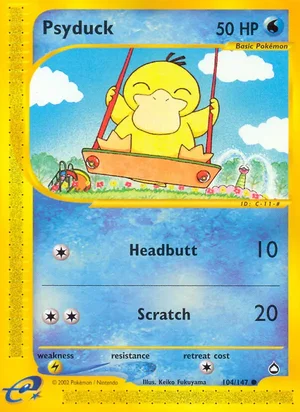
| Reverse Holofoil | 114 | $8,759.55 | Psyduck 104/147 · $700.00 |
TCGplayer market prices in US dollars by printing, from tcgcsv.com, collected on 4 October 2026. The headline price on each card is TCGplayer’s main listing for that card; the line under the card name splits it by printing. Holo and non-holo prints have their own rows. Rare vintage holos sell infrequently, so their market prices can lag behind recent sales.
The 15 most expensive singles
- 1
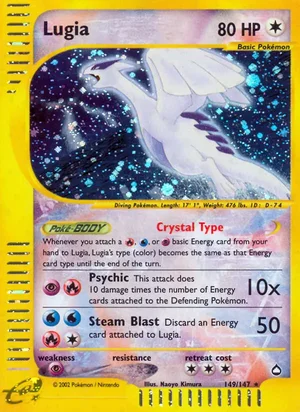 Lugia149/147 · SR · Naoyo Kimura$4,500.00£3,403.84TCGplayer
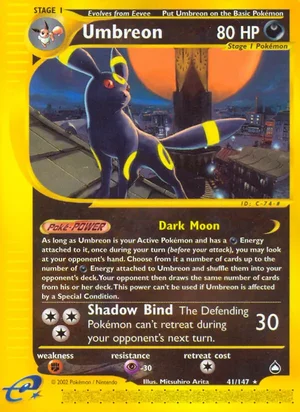
 - 2Umbreon (H29)H29 · H · Mitsuhiro Arita$1,252.62£947.49TCGplayer
- 3Slowking (H22)H22 · H · Aya Kusube$599.99£453.84TCGplayer
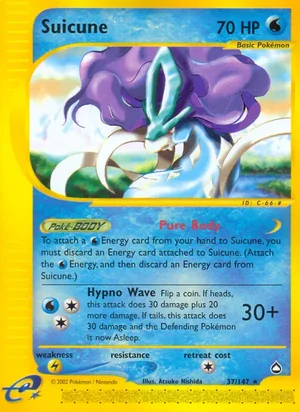
- 4Suicune (H25)H25 · H · Atsuko Nishida$539.99£408.45TCGplayer
- 5
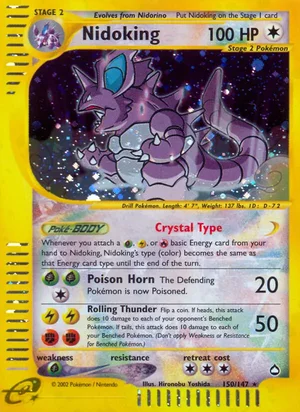 Nidoking (150)150/147 · SR · Hironobu Yoshida$500.00£378.20TCGplayer
 - 6Arcanine (H2)H02 · H · Kyoko Umemoto$475.00£359.29TCGplayer
- 7
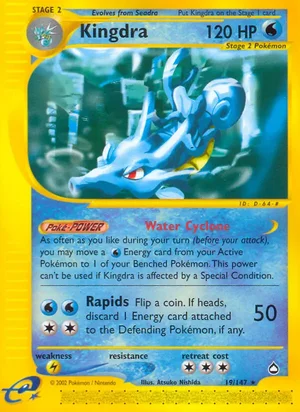
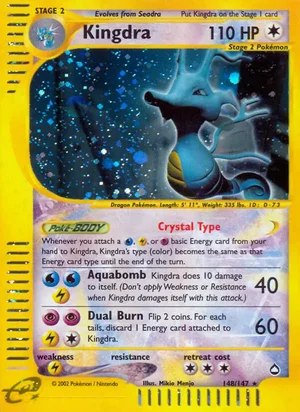 Kingdra (148)148/147 · SR · Mikio Menjo$457.00£345.68TCGplayer
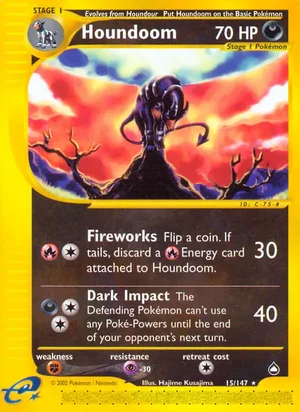
 - 8Houndoom (H11)H11 · H · Hajime Kusajima$399.99£302.56TCGplayer
- 9Ninetales (H19)H19 · H · Kagemaru Himeno$399.99£302.56TCGplayer
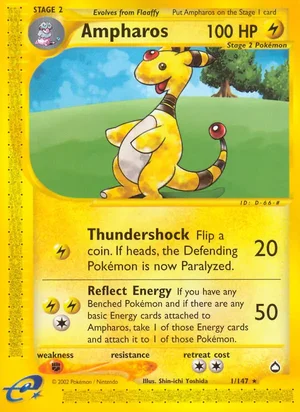
- 10Ampharos (H1)H01 · H · Shin-ichi Yoshida$350.00£264.74TCGplayer
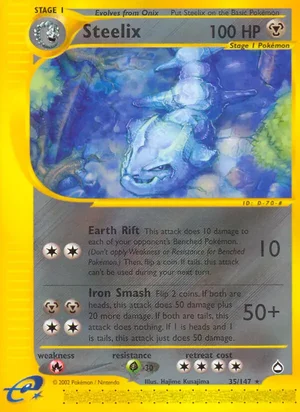
- 11Steelix (H23)H23 · H · Hajime Kusajima$339.95£257.14TCGplayer
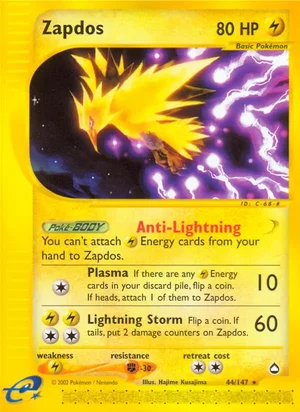
- 12Zapdos (H32)H32 · H · Hajime Kusajima$290.00£219.36TCGplayer
- 13Espeon (H9)H09 · H · Kyoko Umemoto$289.99£219.35TCGplayer
- 14Entei (H8)H08 · H · Atsuko Nishida$273.36£206.77TCGplayer
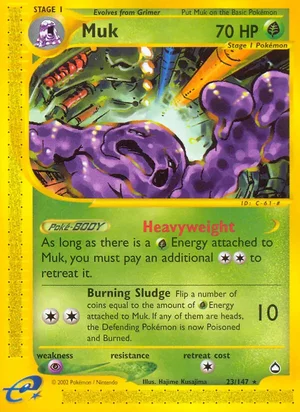
- 15Muk (H17)H17 · H · Hajime Kusajima$256.33£193.89TCGplayer
Aquapolis illustrators
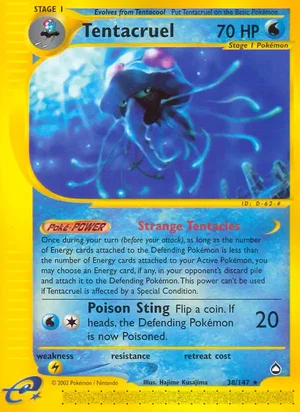
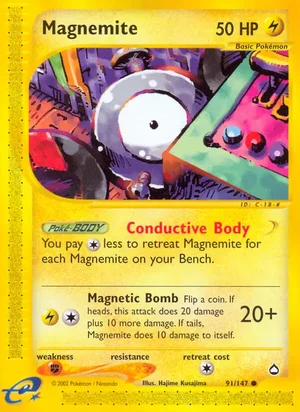
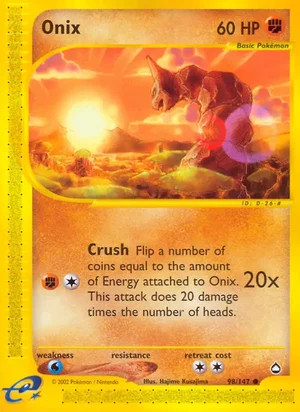
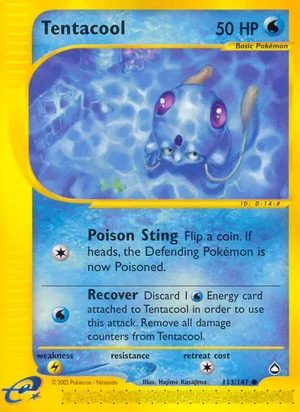
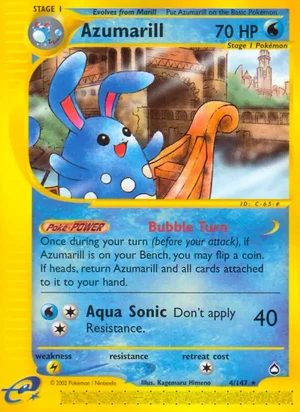
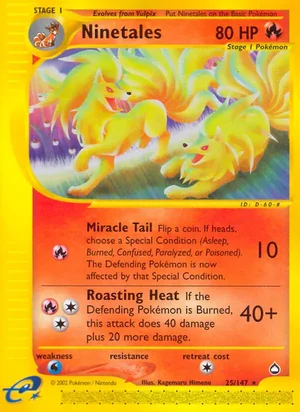
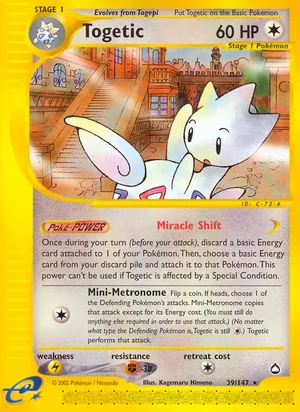
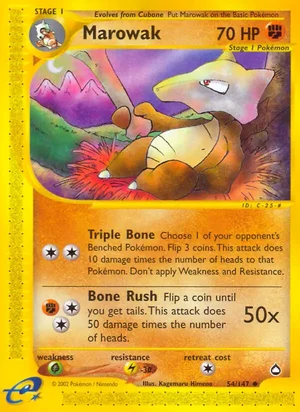
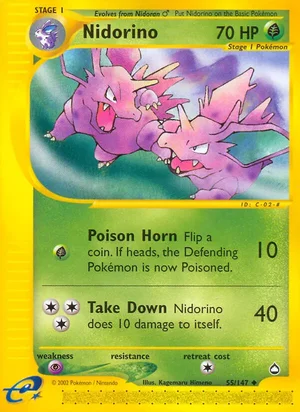
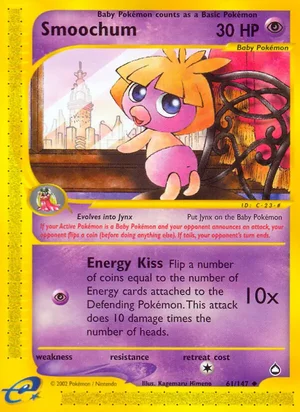
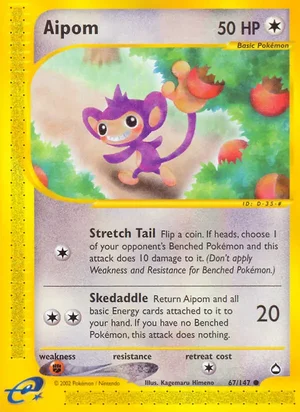
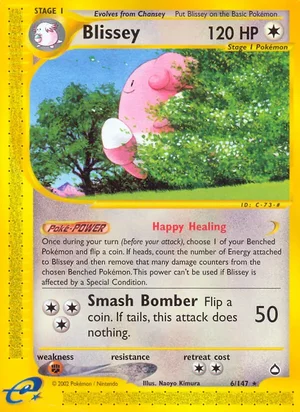
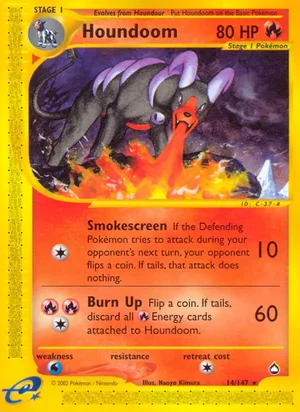
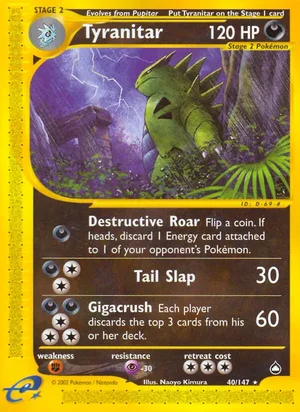
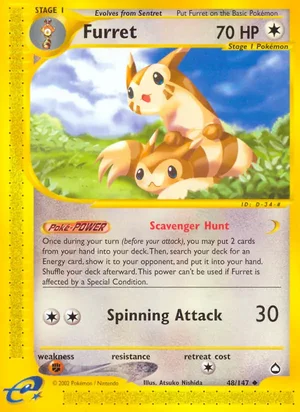
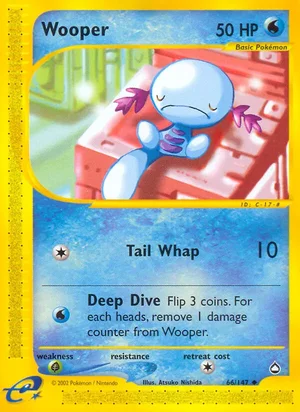
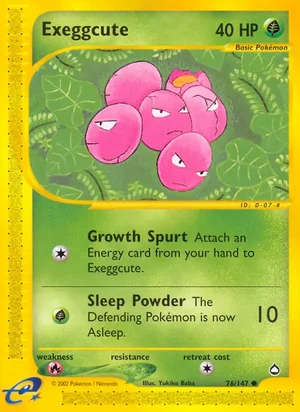
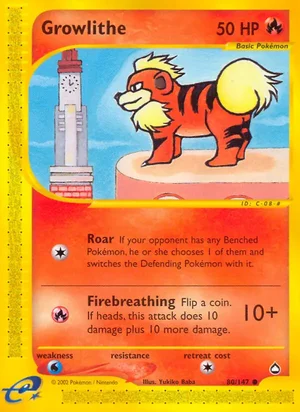
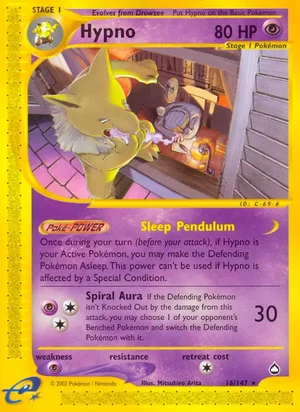
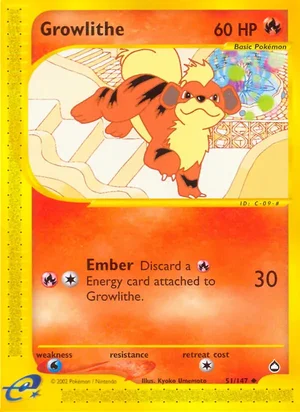
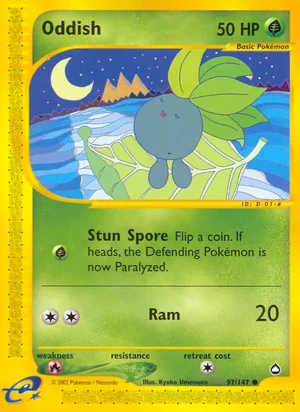
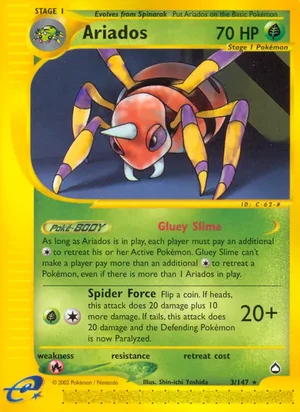
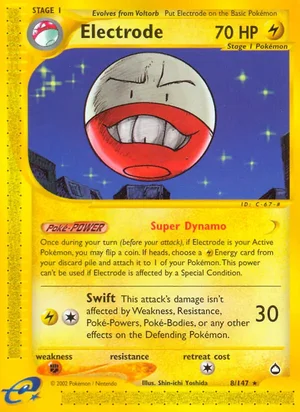
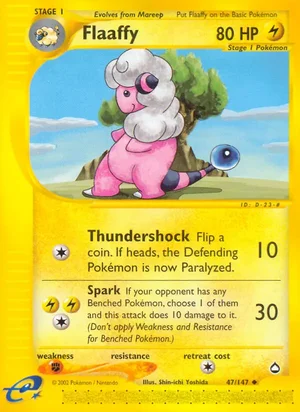
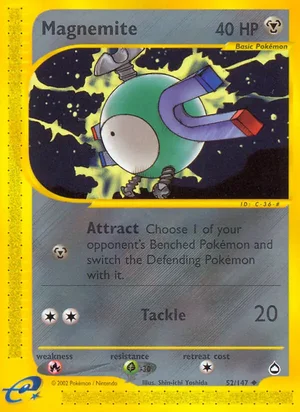
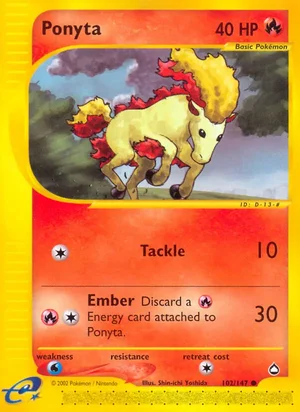
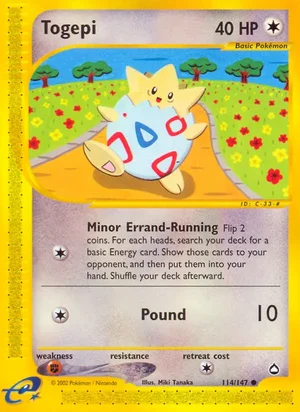
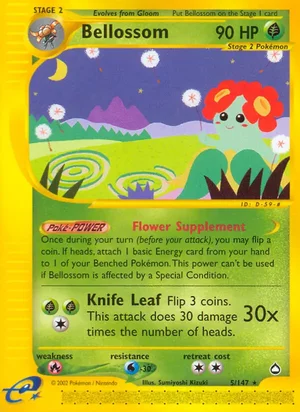
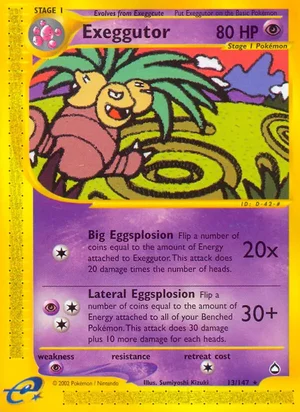
32 illustrators are credited across the set. Hajime Kusajima has the most credits, helped by H holos of his Houndoom, Muk, Steelix, Tentacruel and Zapdos. Naoyo Kimura drew Crystal Lugia as well as Tyranitar, Blissey and the Larvitar line, and Atsuko Nishida drew Suicune, Entei and the non-Crystal Kingdra. Mitsuhiro Arita drew Umbreon and Hypno, Kyoko Umemoto drew Espeon, Arcanine and Vileplume, and Kagemaru Himeno drew Ninetales, Azumarill and Togetic. Ken Sugimori drew all six Supporters, including Juggler and Seer. All eight Cube 01 cards are by "Big Mama" Tagawa, but our data credits only Fire and Grass Cube 01, so the other six do not count towards the tiles below. Each tile leads with the artist's highest-value card in the set; the name links to their entry in the illustrator database.
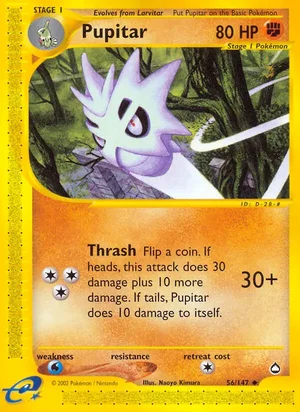
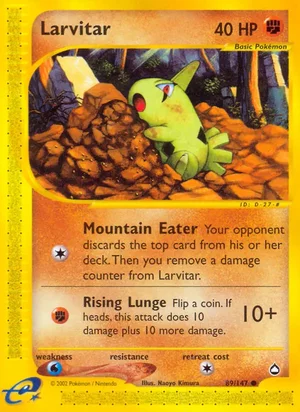
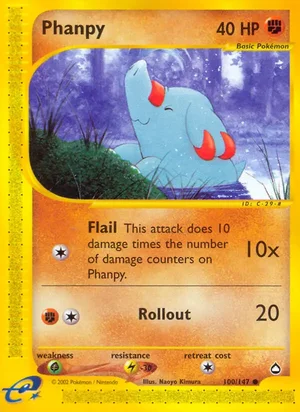
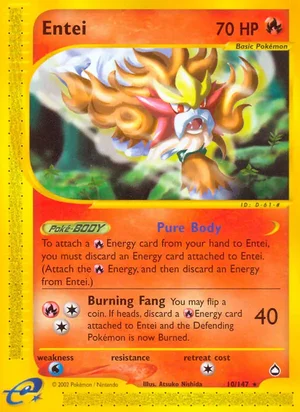
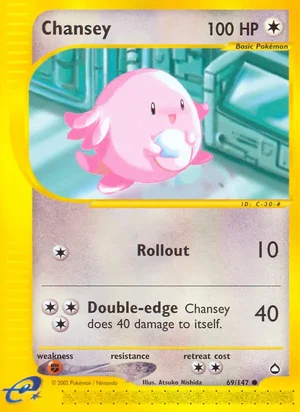
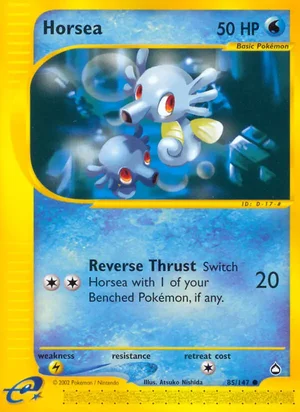
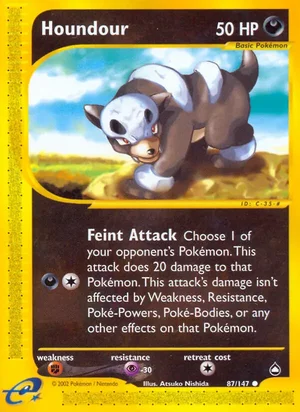
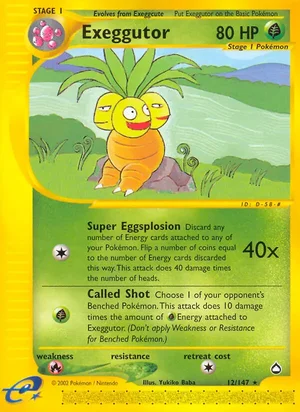
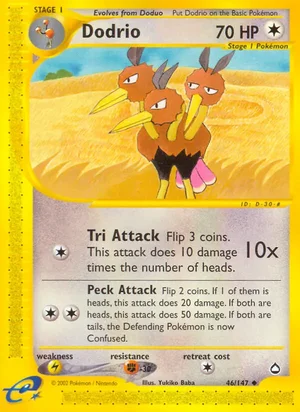
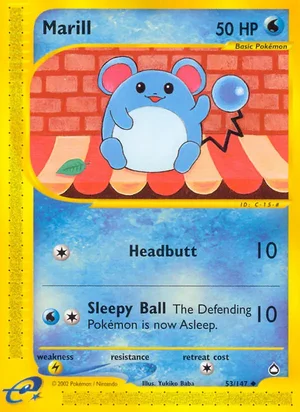
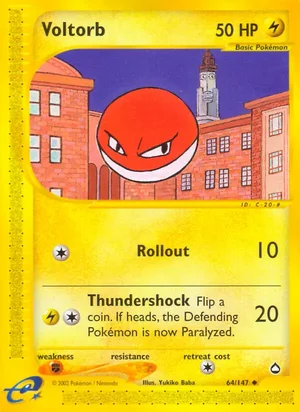
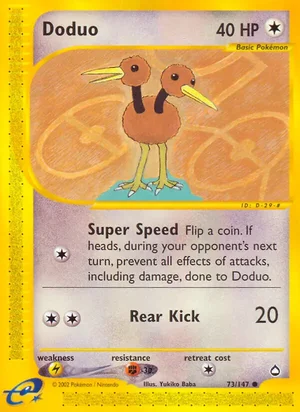
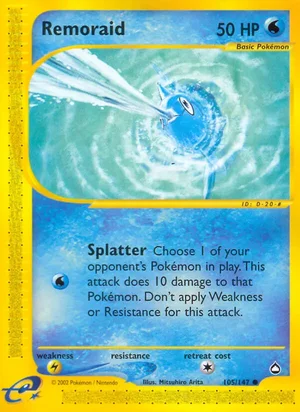
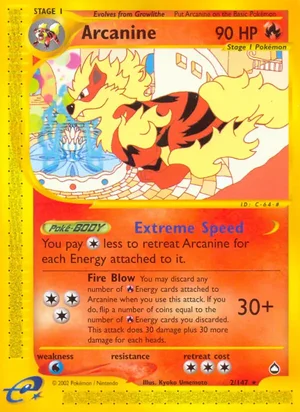
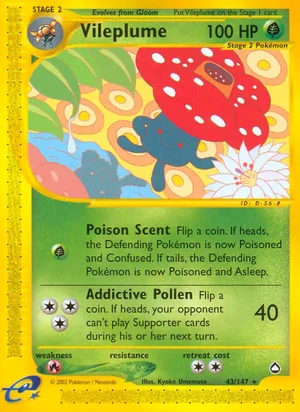
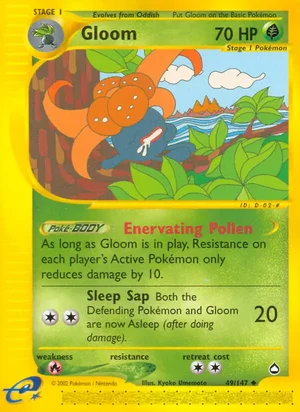
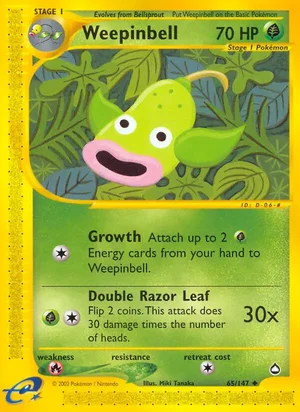
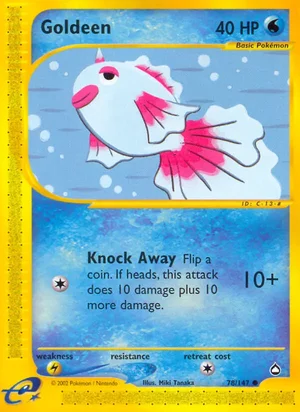
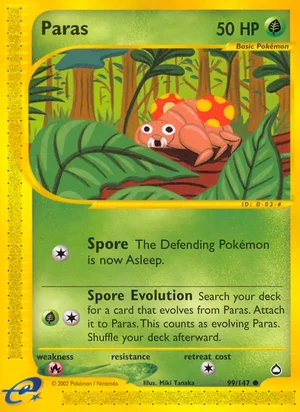
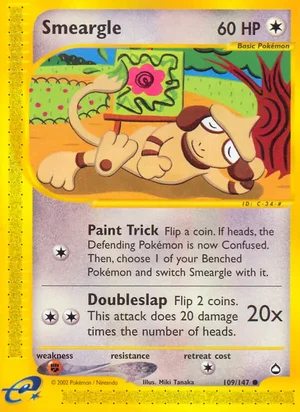
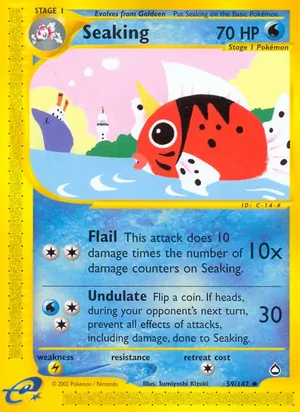
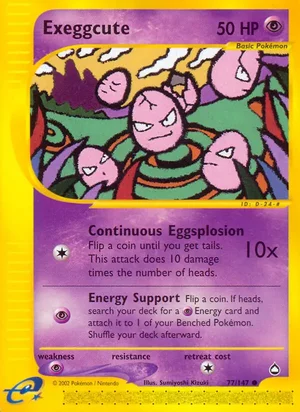
Show all 32 illustrators
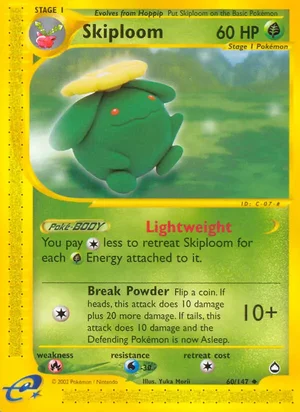
- Midori Harada072, 075, 086, 106, 110, 118, 138
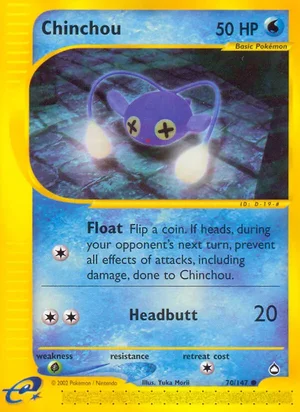
- Tomokazu Komiya029, 063, 081, 082, 092, 112
- Ken Sugimori123, 126, 130, 133, 136, 137
- Shin-ichi Yoshikawa125, 128, 135, 145, 146, 147
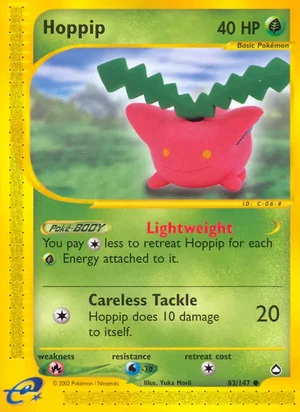
- Keiko Fukuyama068, 096, 104, 116, 117
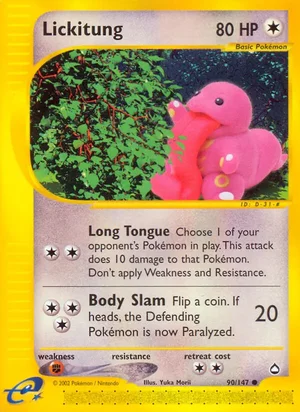
- Masako Yamashita027, 045, 062, 103a, 103b
- Aya Kusube033, 034, 108, H22
- Hikaru Koike009, 022, 028, H16
- Kouki Saitou026, 031, 094, H20
- Keiji Kinebuchi079, 115, 134
- Mikio Menjo120, 148
- Toshinao Aoki088, 101
- Milky Isobe142, 143
- Hizuki Misono093, 107
- "Big Mama" Tagawa122, 124
- Hironobu Yoshida150
- Jungo Suzuki141
- Kazuo Yazawa131
- Takumi Akabane144
- Kai Ishikawa139
Japanese source: The Town on No Map + Wind from the Sea
 Japanese source setThe Town on No MapReleased 8 March 2002 · 92 cards · Aquapolis draws on this set and Wind from the Sea.→
 Japanese source setWind from the SeaReleased 24 May 2002 · 90 cards · Aquapolis draws on this set and The Town on No Map.→
In Japan, Aquapolis was two expansions of the e-Card era: The Town on No Map (地図にない町), released on 8 March 2002 with 92 cards, and Wind from the Sea (海からの風), released on 24 May 2002 with 87 numbered cards and three secret cards, 90 in all. All three Crystal Pokémon are Wind from the Sea secret cards: Nidoking 088/087, Kingdra 089/087 and Lugia 090/087. In Japanese they are called Neutral Pokémon. The Technical Machine Cube 01 cards, Pokémon Park, Power Plant and Rainbow Energy come from The Town on No Map; the Berries, Time Shard, Undersea Ruins, Apricorn Forest and the Crystal, Boost and Warp Energy come from Wind from the Sea. In Japan the holo and non-holo prints of a Rare had separate numbers in the main list; Suicune, for example, is 030/092 and 031/092 in The Town on No Map, where Aquapolis has 37/147 and H25/H32. Golduck had two Dot Code versions in Japan too, but there they share one card number.
Aquapolis products and sealed prices
Aquapolis was sold in 9-card booster packs, each with one reverse holo, in four pack artworks: Arcanine, Scizor, Entei and Tyranitar. Two theme decks came out with the set: Rock Garden, a Fighting and Grass deck, and Abyss, a Fire and Water deck. Booster boxes also held an oversized reverse holo box topper: Entei, Espeon, Scizor or Suicune. TCGplayer lists only the loose booster pack in our snapshot. Sealed prices are market prices from the same snapshot as the singles.
 No photo yet
Booster Pack
9 cards including one reverse holo, in Arcanine, Scizor, Entei and Tyranitar artworks
Collector's notes
Crystal Pokémon are the set's secret rares
Kingdra, Lugia and Nidoking are numbered past the end of the set, 148/147 to 150/147, and Bulbapedia notes that every Crystal Pokémon was a secret card in both languages. They exist only as holofoil, with no reverse holo or non-holo print. Skyridge later added six more, so a full run of English Crystal Pokémon is nine cards across two sets.
The H holos are separate cards
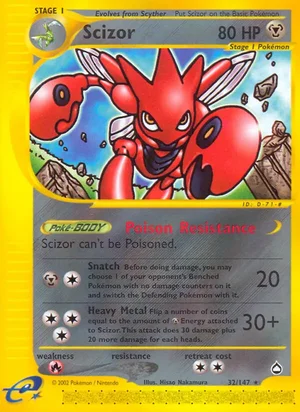
Thirty-two Rares have a second, holofoil print numbered H1/H32 to H32/H32, with the same artwork as the regular Rare. A master set therefore needs the regular Rare, its reverse holo and the H holo; the H holo has its own tile and price in the list, and the line under the regular Rare gives its regular and reverse holo prices. The regular Rare is not holofoil, so a card numbered 37/147 is never the Suicune holo; that is H25/H32.
Four cards come in 'a' and 'b' versions
Golduck, Drowzee, Mr. Mime and Porygon were each printed as an 'a' and a 'b' card. Bulbapedia notes the two are identical apart from their Dot Code data: Golduck 50a carries map data for the e-Reader's Construction: Action game, while 50b holds a hidden attack, Spiral Damage. Look at the card number to tell them apart, and remember both have reverse holos, which makes eight extra cards for a master set.
No official pull rates
Bulbapedia notes that the precise odds of pulling ultra rare cards were never officially published, so any Crystal Pokémon pull rate you see is a community estimate. Each pack has one reverse holo slot on top of its rare, so a pack can hold two Rares.
More e-Card/EX era set guides
Every English set of the e-Card/EX era in release order.
- Expedition Base Set15 September 2002 · 165 cards
- Aquapolis15 January 2003 · 186 cards
- Skyridge12 May 2003 · 182 cards
- EX Ruby & Sapphire18 June 2003 · 109 cards
- EX Sandstorm18 September 2003 · 100 cards
- EX Dragon24 November 2003 · 100 cards
- EX Team Magma vs Team Aqua1 March 2004 · 97 cards
- EX Hidden Legends1 June 2004 · 102 cards
- EX FireRed & LeafGreen30 August 2004 · 116 cards
- EX Team Rocket Returns8 November 2004 · 111 cards
- EX Deoxys14 February 2005 · 108 cards
- EX Emerald9 May 2005 · 107 cards
- EX Unseen Forces22 August 2005 · 145 cards
- EX Delta Species31 October 2005 · 114 cards
- EX Legend Maker13 February 2006 · 93 cards
- EX Holon Phantoms3 May 2006 · 111 cards
- EX Crystal Guardians30 August 2006 · 100 cards
- EX Dragon Frontiers8 November 2006 · 101 cards
- EX Power Keepers14 February 2007 · 108 cards
Aquapolis FAQ
When did Aquapolis come out?
The English set released on 15 January 2003. Its Japanese sources, The Town on No Map and Wind from the Sea, came out on 8 March and 24 May 2002.
How many cards are in Aquapolis?
186. The main list has 147 cards, three Crystal Pokémon secret rares follow as 148/147 to 150/147, 32 holo Rares are numbered H1/H32 to H32/H32, and Golduck, Drowzee, Mr. Mime and Porygon each have an 'a' and a 'b' print.
What is the most valuable Aquapolis card?
By market price on 4 October 2026, Lugia (149/147, Secret Rare) at $4,500.00 (£3,403.84). The prices table on this page shows the top 15, and the Prices by printing table names the top card among the holo, regular and reverse holo prints.
What are the Crystal Pokémon in Aquapolis?
Kingdra (148/147), Lugia (149/147) and Nidoking (150/147). They are Colorless, and their Crystal Type Poké-Body changes their type for the turn to match a basic Energy card you attach from your hand, from three types named on each card; Lugia's are Fire, Water and Psychic. Aquapolis introduced them, and Skyridge added six more.
What do the H numbers on Aquapolis cards mean?
H1/H32 to H32/H32 are the holofoil versions of 32 of the set's 44 Rare Pokémon. Aquapolis numbered them apart from the main 147 cards, so the holo and the reverse holo of the same Rare would not share a number.
What Japanese sets is Aquapolis based on?
Two e-Card era expansions: The Town on No Map (92 cards, March 2002) and Wind from the Sea (90 cards, May 2002). The three Crystal Pokémon come from Wind from the Sea.
Are Aquapolis cards legal in tournaments?
No. Aquapolis is not legal in the Standard or Expanded formats; Expanded begins with the Black & White series. The cards can be played in fan-run vintage formats and in casual games.